
Young athletes are not small adults. Their bones are still growing, and the growth plates where large tendons attach (the apophyses) are often the weakest link in the chain. When training loads climb faster than those growth centers can adapt, the result is apophysitis: a painful, activity-related overload injury that shows up most often between ages 8 and 15.
The mission of this blog is simple: give chiropractors a clear, evidence-based playbook for the growing athletes who walk into their clinics. Below, we answer the five questions chiropractors search for most when a young patient presents with heel, knee, or elbow pain. We cover the three most common growth plate injuries in athletes under 16, how to separate an overuse injury from a fracture that needs referral, how to adjust safely around open growth plates, how to treat each condition, and how to guide a safe return to sport.
Every section is grounded in published research and in the evidence-based approach ChiroUp champions: assess thoroughly, rule out red flags, educate the family, and pair hands-on care with a progressive exercise plan. The goal is not just to calm today's pain, but to keep these kids healthy and in the game for years.
1. What Are the Most Common Growth Plate Injuries in Young Athletes?
The three most common apophyseal injuries in athletes under 16 are Osgood-Schlatter disease, Sever's disease, and Little League elbow. Each is a traction injury: a strong muscle-tendon unit pulls repeatedly on a growth center that has not yet fused to the rest of the bone. (1)
| Condition | Growth Plate Affected | Typical Age | Common Sports | Key Exam Finding |
|---|---|---|---|---|
| Osgood-Schlatter disease | Tibial tubercle (patellar tendon insertion) | Girls about 8–13, boys about 10–15 | Basketball, volleyball, soccer, track | Tender, often enlarged tibial tubercle; pain with resisted knee extension |
| Sever's disease (calcaneal apophysitis) | Posterior calcaneus (Achilles insertion) | About 8–12 | Soccer, gymnastics, running sports | Positive calcaneal squeeze test; pain with heel raises |
| Little League elbow (medial epicondyle apophysitis) | Medial epicondyle (flexor-pronator origin) | About 9–12 | Baseball pitchers, other overhead throwers | Medial elbow tenderness; pain with valgus stress and resisted wrist flexion |
All three share a pattern: gradual onset, pain that worsens with activity and eases with rest, and a link to growth spurts, rising training volume, and early single-sport specialization. Age ranges vary by source and track skeletal maturity more than birthdays, so treat them as a guide.
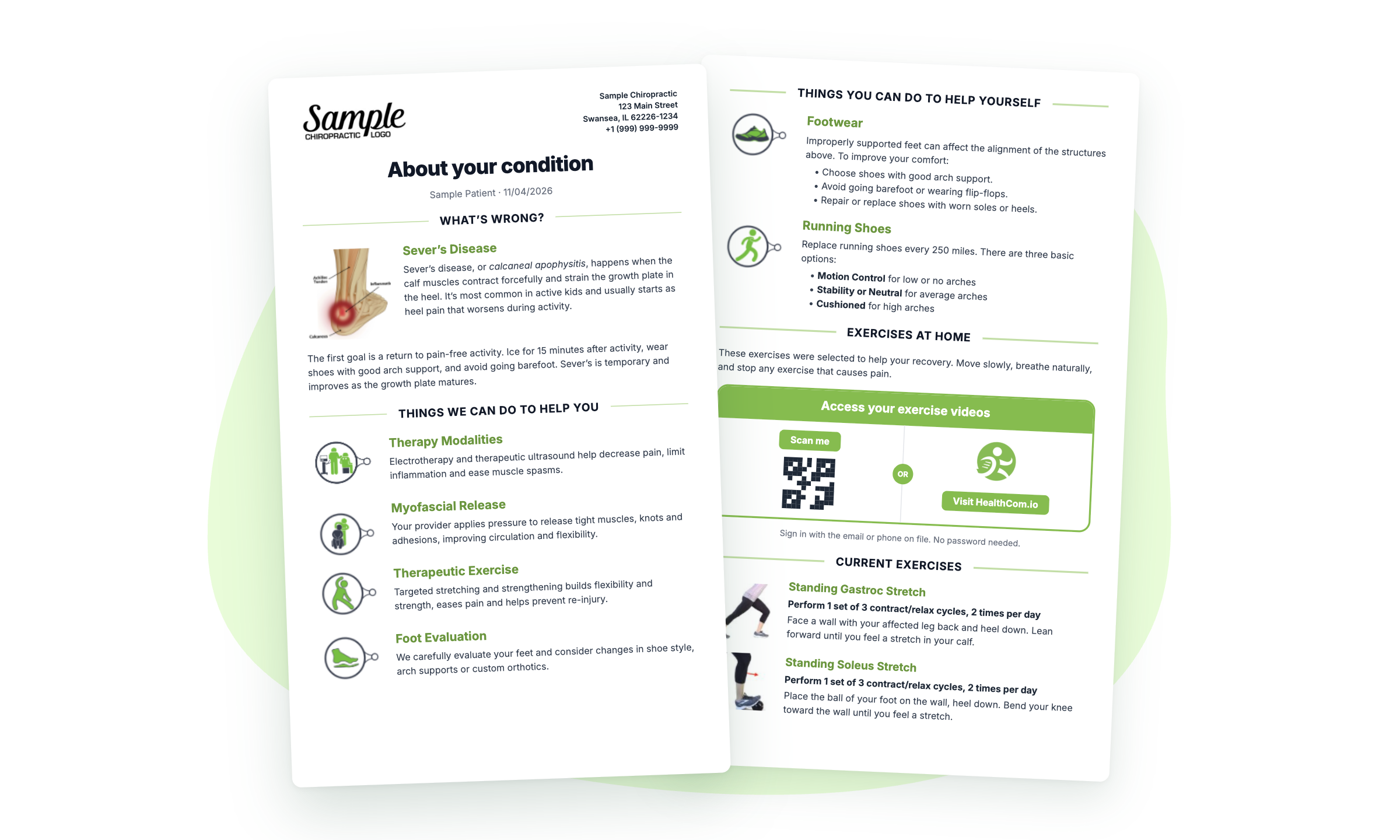
The evidence-based chiropractic angle: ChiroUp's condition protocols are built around exactly this kind of structured, reference-backed assessment. Pair your diagnosis with a condition report the family can take home. When parents understand that the pain comes from a growing bone being overloaded, not a "pulled muscle," they are far more likely to follow your activity plan.
2. How Do You Tell Apophysitis Apart From a Growth Plate Fracture?
Apophysitis builds slowly; a fracture usually starts with a moment. The history is your strongest tool: a gradual, activity-related ache points to overuse, while a sudden pop during a jump, sprint, or throw, followed by swelling and loss of function, points to an avulsion fracture that needs imaging and referral. (2)
Apophysitis is usually a clinical diagnosis, and routine imaging is not required when the history and exam fit.
So which signs and symptoms should raise concern? Chiropractors have long been criticized for imaging too often. With young athletes, the opposite mistake matters just as much: missing the injury that truly needs an X-ray. Image or refer when the picture does not fit:
| What You Find | What It Suggests | Next Step |
|---|---|---|
| Sudden onset with a pop, immediate swelling, or bruising | Apophyseal avulsion fracture | Radiographs; orthopedic referral |
| Unable to bear weight, perform a straight-leg raise, or extend the knee or elbow fully | Disrupted extensor or flexor mechanism | Same-day imaging and referral |
| Joint effusion, tense swelling, or pain out of proportion | Fracture, intra-articular injury, or compartment concern | Urgent referral |
| Night pain, fever, weight loss, or general malaise | Infection, inflammatory disease, or malignancy | Medical referral and workup |
| Symptoms that fail to improve after 4–6 weeks of good conservative care | Missed diagnosis | Imaging; reassess the diagnosis |
Two details matter for chiropractors. Tibial tubercle avulsions tend to occur in adolescents nearing skeletal maturity, often in jumping sports. Some research also reports pre-existing Osgood-Schlatter disease in patients with these fractures, although a causal link is not established. A history of Osgood-Schlatter is a reason to take any acute flare seriously, not to dismiss it.
The evidence-based chiropractic angle: ChiroUp's protocols put red-flag screening and case review ahead of treatment, and its PCP referral program supports building relationships with local physicians. A young athlete you refer appropriately, with a clear report to the pediatrician or orthopedist, builds trust with the family and the medical community.
3. Is It Safe to Adjust a Child With Open Growth Plates?
Yes, with modification. Open growth plates are not a contraindication to chiropractic care, but they change how you deliver it. The rule is simple: never load an irritated apophysis directly, and scale force to the child's size and age. (3)
Practical guidelines for the treatment room:
Stay off the sore spot. Avoid thrust, deep pressure, or aggressive instrument work directly over the tibial tubercle, calcaneal apophysis, or medial epicondyle while they are symptomatic.
Scale your force. Children's tissues are more compliant than adults'. Favor low-force techniques, mobilization, and instrument-assisted adjusting, and reserve full thrust for older adolescents when clearly indicated.
Treat the kinetic chain. Address the regions that drive load to the painful site: the lumbopelvic region and hips for knee apophysitis, the foot and ankle for Sever's, and the thoracic spine, scapula, and shoulder for throwers.
Be honest about the evidence. There are no trials showing that manipulation heals apophysitis. Present adjustments as one part of a plan whose foundation is load management and exercise.
Get consent from the parent and assent from the child. Explain what you will do, why, and what the child may feel.
The evidence-based chiropractic angle: This is where evidence-based chiropractic separates itself. ChiroUp's condition reports lay out in-office treatment, goals, expected duration, and home advice in plain language, so the family sees that adjustments support the plan rather than replace it. That transparency protects the child and builds the profession's credibility with pediatricians.
4. What Is the Best Chiropractic Treatment Protocol for Osgood-Schlatter, Sever's, and Other Apophysitis?
The best-supported plan is active, not passive: temporarily reduce the load that aggravates the growth plate, keep the athlete strong, then rebuild tolerance step by step. Hands-on care supports that plan by easing pain and improving mechanics through the kinetic chain.
In 51 adolescents with a mean age of 12.7, a 12-week program of activity modification and progressive strengthening produced a successful outcome in 80% at 12 weeks and 90% at one year. (4)
A 12-week framework for all three conditions:
| Phase | Goal | What It Includes |
|---|---|---|
| Weeks 0–4: Calm | Reduce pain and irritability | Pause or scale back aggravating sport; pain monitoring (keep pain at or below 2/10 during activity and the next morning); isometric holds; soft tissue work away from the apophysis; kinetic-chain adjusting; ice, taping, or bracing as needed |
| Weeks 5–8: Build | Restore strength and flexibility | Progressive strengthening (wall squats, squats, lunges, calf raises, scapular and cuff work); flexibility for the quads, hamstrings, calves, and forearm flexors; balance and landing mechanics |
| Weeks 9–12: Return | Rebuild sport tolerance | Graded return using an activity ladder; sport-specific drills; full competition once training is pain-free |
Condition-specific additions:
Osgood-Schlatter disease: Emphasize quadriceps and hip strengthening and limit jump volume early. A patellar strap may reduce pain during sport for some athletes.
Sever's disease: Heel cups or heel lifts, supportive footwear, and calf flexibility are the core of care. Limit barefoot activity and running on hard surfaces during flares.
Little League elbow: Throwing stops completely during the calm phase, followed by a structured interval throwing program. Strengthen the scapula, rotator cuff, and core, and counsel families on pitch counts and rest using MLB's Pitch Smart guidelines.
The evidence-based chiropractic angle: Compliance is where these cases are won or lost. ChiroUp's condition reports include a lay description of the condition, the in-office treatment plan, expected duration, advice on daily living, and exercises with video demonstrations. Sending one at the first visit gives the athlete and the parent the same plan you discussed in the room.
5. How Long Does Apophysitis Take to Heal, and When Can a Young Athlete Return to Sport?
Most athletes return within weeks to a few months, but symptoms can flare on and off until the growth plate fuses. Set that expectation at the first visit: the goal is not to wait out the condition on the bench, but to manage load so the athlete keeps playing with tolerable or no pain.
Typical timelines vary widely with sport, growth stage, and how well load is managed. As a general guide, Sever's disease and Little League elbow often settle over several weeks to a few months with a full throwing pause and interval program for the elbow. Osgood-Schlatter can recur over many months, and lingering tubercle tenderness or a bump may persist until skeletal maturity. Recurrent cases usually take longer than first episodes.
In elite youth soccer players [with Sever’s Disease], the mean return-to-play was about 61 days, with wide variation, and recurrent cases took longer to return than first-time cases. (5)
Return-to-play checklist:
Pain at or below 2/10 during activity and the next morning
No tenderness that worsens with sport-specific loading
Full, pain-free range of motion and flexibility
Strength and single-leg hop or throwing tests roughly equal side to side
Completed the top rung of the activity ladder
About two weeks of unrestricted, pain-free training before full competition
A prevention plan in place: training volume, rest days, footwear, and pitch counts for throwers
Keep the athlete moving during recovery. Swimming, cycling, upper-body work for lower-limb cases, and lower-body conditioning for throwers protect fitness and help kids stay connected to their team.
The evidence-based chiropractic angle: Track outcomes so the return decision is data-driven, not guesswork. ChiroUp's outcome assessments and provider statistics let you measure progress across visits, and its case review approach flags any condition that stalls for two or three consecutive visits. That is your cue to reassess, adjust the plan, or refer.
Frequently Asked Questions
-
Osgood-Schlatter disease, Sever's disease, and Little League elbow. All are overuse traction injuries at a growth center where a major tendon attaches.
-
Apophysitis has a gradual, activity-related onset. A sudden pop, rapid swelling, or inability to bear weight or extend the joint suggests an avulsion fracture that needs imaging and referral.
-
Yes, with modified force and no direct loading of an irritated apophysis. Adjusting supports the plan; load management and exercise drive it.
-
Temporary activity modification, pain monitoring, and progressive strengthening, plus heel cups for Sever's. Hands-on care helps by easing pain and improving mechanics.
-
When pain stays at or below 2/10 during activity and the next morning, strength is restored, and they have completed a graded progression with about two weeks of pain-free training.
Keep Young Athletes in the Game
Growth plate injuries are a common concern in young athletes, but with a thorough examination, clear patient communication, and an active, evidence-based treatment plan, chiropractors can confidently guide patients toward recovery.
Want to streamline your clinical decision-making? Explore ChiroUp’s evidence-based condition protocols, customizable patient reports, and exercise videos to simplify care and improve patient outcomes.
-
Lintner LJ, Swisher J, Sitton ZE. Childhood and Adolescent Sports-Related Overuse Injuries. American Family Physician. 2023;108(6):544-553.
Delos Reyes C, Wu W, Pandya NK. Adolescent Tibial Tubercle Fracture: Review of Outcomes and Complications. Current Reviews in Musculoskeletal Medicine. 2023;16(9).
Hawk C, Schneider MJ, Vallone S, Hewitt EG. Best Practices for Chiropractic Care of Children: A Consensus Update. Journal of Manipulative and Physiological Therapeutics. 2016;39(3):158-168.
Rathleff MS, Winiarski L, Krommes K, et al. Activity Modification and Knee Strengthening for Osgood-Schlatter Disease: A Prospective Cohort Study. Orthopaedic Journal of Sports Medicine. 2020;8(4):2325967120911106.
Belikan P, Färber LC, Abel F, et al. Incidence of calcaneal apophysitis (Sever's disease) and return-to-play in adolescent athletes of a German youth soccer academy: a retrospective study of 10 years. Journal of Orthopaedic Surgery and Research. 2022;17:83.