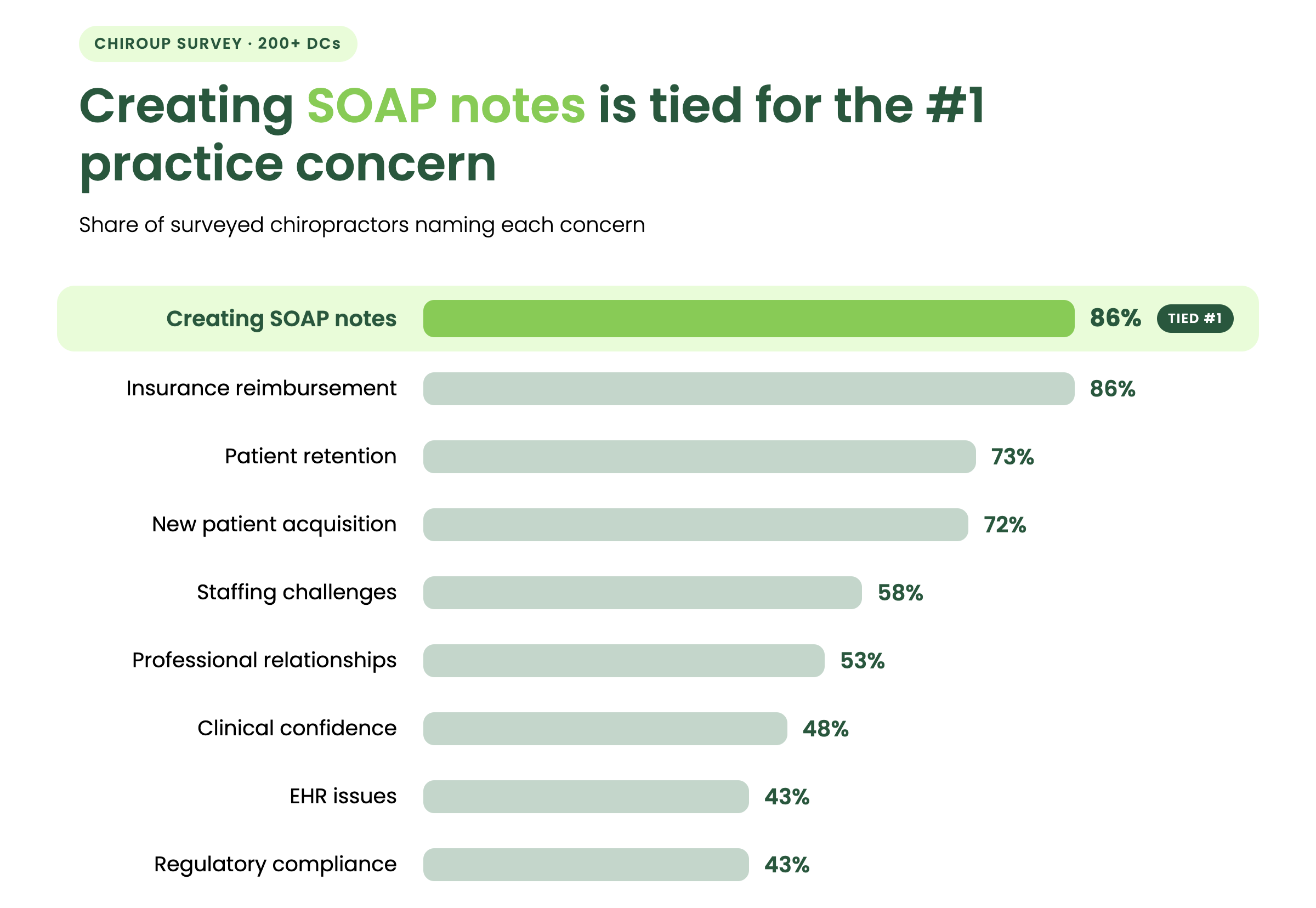
Ask a room of chiropractors what drains their day, and SOAP notes come up fast. When ChiroUp surveyed more than 200 DCs about their biggest practice concerns, 86% named creating SOAP notes as a top concern. That tied with insurance reimbursement for the number one spot, ahead of patient retention (73%) and new patient acquisition (72%).
That makes sense. The note is where clinical care, compliance, and payment all meet. A weak note can cost you a claim. A slow note costs you your evening.
And it's more than a frustration. In a survey of nearly 1,800 physicians, those who reported time concerns for documentation had 2.8 times the odds of burnout. (1)
The industry has offered three main fixes: SALT (Same as Last Time), more templates, and now AI scribes that try to write the entire note. All sound good. All have real limits for hands-on providers.
This blog covers what a strong chiropractic SOAP note needs today, why "same as last time" charting has become a liability, where AI voice charting helps and where it falls short, and why we flipped SOAP to SAOP.
Key Takeaways
- SOAP notes are a major pain point. 86% of chiropractors surveyed by ChiroUp identified SOAP note creation as a top practice concern.
- Cloned notes put reimbursement at risk. SALT ("same as last time") documentation can fail to demonstrate patient progress and medical necessity.
- Traditional templates have limitations. Generic templates can create repetitive notes that don't accurately reflect each patient's condition or progress.
- AI scribes can't capture everything. Voice charting works well for subjective histories but often misses the hands-on exams and treatments essential to chiropractic care.
- There's a faster way to document. ChiroUp's SAOP approach uses the diagnosis to suggest relevant findings and treatments for provider confirmation. More than 80% of surveyed ChiroUp users report saving 1–3 minutes or more per note.
1. What Goes in a Chiropractic SOAP Note?
Fast Fact: You know the four letters. Auditors look at what's between them.
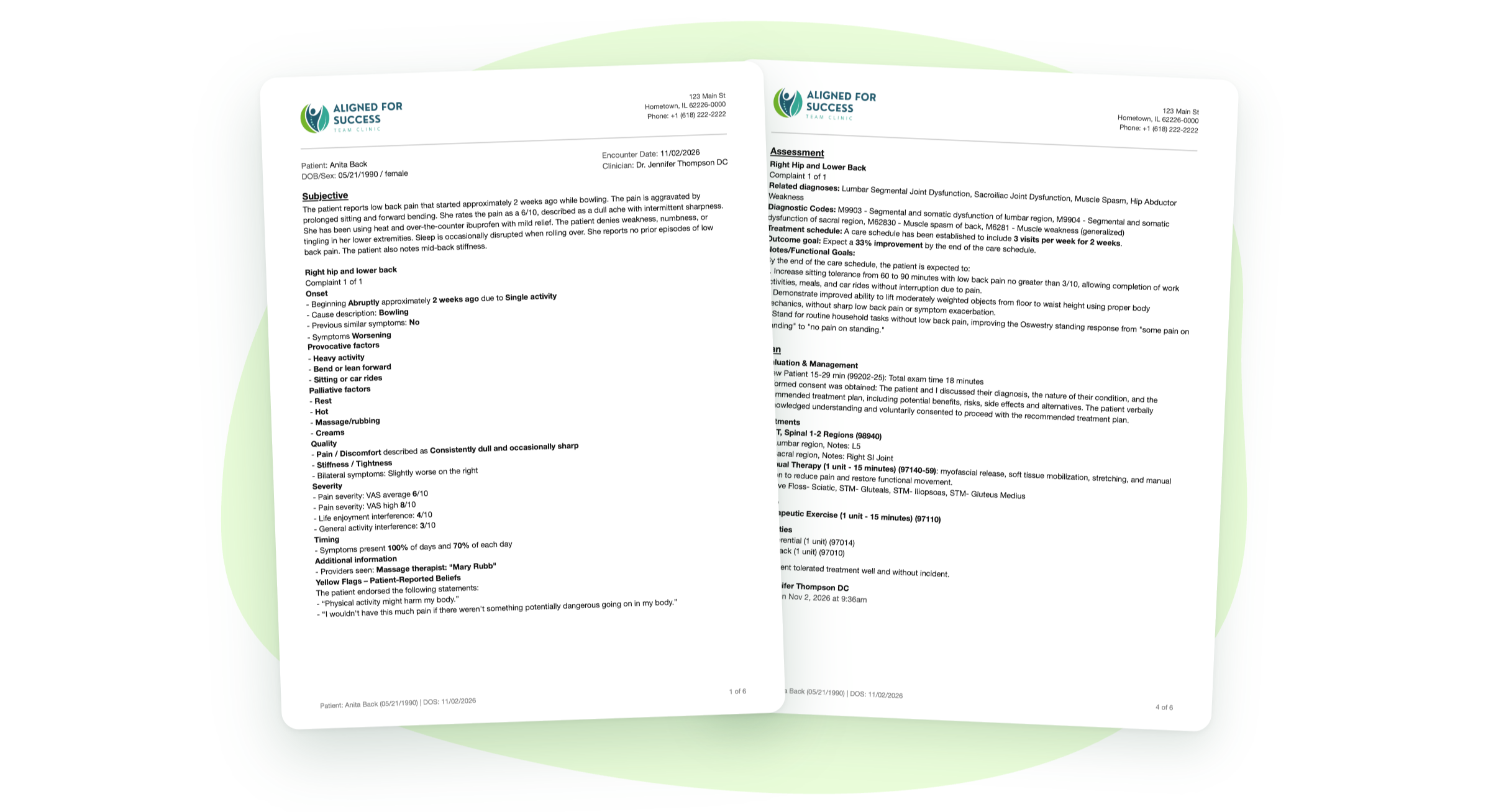
A strong chiropractic SOAP note shows function and measurable change, an exam that supports the diagnosis, measurable goals, and findings.
You already know what Subjective, Objective, Assessment, and Plan stand for. What trips up most DCs isn't the format. It's the details payers expect to see and often don't. Medicare contractors and commercial payers repeatedly flag the same gaps:
Function, not just pain. Stating that the patient has pain, along with a pain scale, is not sufficient to support medical necessity. Daily notes need functional and measurable elements in both the subjective and objective portions. (2) Functional disability scores, such as the Oswestry or Neck Disability Index, are one way to capture this, and an automated system for sending, following up on, and documenting them saves a lot of time.
An exam that matches the diagnosis. Document examination of the spinal areas involved in the diagnosis, every region adjusted, and the diagnosis codes for each level billed. (2) Include the myofascial, ROM, and neurologic findings that justify manual therapy or exercise.
Measurable goals, frequency, and duration. Common errors include treatment plans with no measurable goals and no frequency or duration of care. (3)
Change since the last visit. Subsequent visits should assess change in the patient's condition since the last visit. (4) Document functional improvement, not just a drop in pain.
How the patient responded. Document the treatment you provided and the patient's response to care. (2)
P.A.R.T. findings. Although P.A.R.T. documentation was originally established for Medicare patients, it is also an appropriate standard for most other payers. Beyond the pain findings typically recorded in the Subjective section, the examination must provide objective evidence of a need for spinal manipulation (aka a subluxation). Documentation should include at least two of the four P.A.R.T. criteria, with at least one being asymmetry/misalignment or a range-of-motion abnormality. (2, 5) Most of these findings live in the Objective:
Pain or tenderness, by location, quality, and intensity- i.e., tenderness is elicited when the L3/L4 region is palpated.
Asymmetry or misalignment, at the sectional or segmental level- e.g., the L3 spinous process is rotated to the right, and the L4 spinous is rotated left. The right hip appears higher than the left.
Range-of-motion abnormality- e.g., Right lumbar lateral bending and flexion are reduced as recorded by inclinometry.
Tissue or tone changes in the surrounding soft tissues- e.g., Hypertonicity is palpated in the lumbar paraspinal region
2. Why Do Follow-Up Notes Matter So Much?
Fast Fact: A static note implies static progress.
Most of your documentation isn't initial examinations. It's during follow-up visits that the medical necessity for ongoing care is established or challenged.
The initial examination establishes the medical necessity for starting care, but subsequent visits must justify continuing it. Follow-up notes should demonstrate the patient’s response to treatment and document measurable progress toward functional goals. Notes that remain virtually unchanged from visit to visit suggest a lack of progress and can put reimbursement at risk.
Medicare contractors list subsequent visits that fail to assess progress since the previous visit or against the goals in the treatment plan as among the most common documentation errors. (3) Some commercial payers go further. Aetna's policy considers continued chiropractic treatment not medically necessary if no improvement is documented within 30 days, despite treatment modifications. (6)
Think about what a static note says. If today's note reads like last week's, it tells the reader your patient isn't changing. No change means no progress. And no progress looks like maintenance care, which insurers don't want to pay for, or worse, want their money back for.
That isn't hypothetical. CMS reported roughly $389 million in improper chiropractic payments for the 2013 reporting period, attributed to services that were medically unnecessary, incorrectly coded, or insufficiently documented. (7) In one OIG audit of an individual practice, the records did not support medical necessity for 92 of 100 sampled services. (8)
Your notes need to show that the patient is improving subjectively, in pain and especially in function, and that the objective findings are changing in proportion. If the note doesn't show it, it didn't happen.
3. Are SALT Notes Putting Your Practice at Risk?
Fast Fact: Fast to write. Expensive to defend.
Yes. SALT notes copy the last visit forward, which can look like cloned documentation that doesn't support medical necessity, and payers increasingly use software to spot them.
SALT, short for "same as last time" or "same as last treatment," copies the previous note forward into today's visit. It's fast. That's why so many EHRs offer it. But speed is the only thing it has going for it.
A SALT note is a liability on several fronts:
It looks cloned. Medicare contractor guidance describes cloned documentation as entries worded exactly like or similar to previous entries, and states that it does not meet medical necessity requirements because it lacks specific, individual information. (9)
It isn't encounter-specific. For software-generated notes, CMS expects documentation of the specific elements of the service for this patient on this day of service. (2)
It looks sloppy. A reviewer sees the same words, visit after visit, and draws conclusions about the care behind them.
It tells you nothing. When you open last week's note, you can't tell what actually changed. Neither can your associate, the patient's PCP, or an attorney reviewing a personal injury case.
You're not alone if you've leaned on it. A study of more than 104 million clinical notes found that 50.1% of the text was duplicated from earlier documentation, rising from 33% in 2015 to 54.2% in 2020. (10)
Payers Are Using AI to Find Cloned Notes
The rules haven't changed, but the enforcement tools have. Payment integrity vendors now offer health plans AI that flags cloned and duplicated records. (11) Healthcare attorneys describe carriers using AI to scan large volumes of notes for repetitive and cloned phrasing across a provider's patients. (12) At a 2026 conference, documentation experts described software that flags copied notes and hands them to human auditors, which is where external audits begin. (13) A SALTed note that once slipped by in a stack of paper is now easy for software to spot. Some of these tools are also built to flag records that were partly or fully generated by AI. (11) As they spread, a note written start to finish by AI, with little sign of the clinician in it, may draw extra scrutiny of its own.
SALT checked a box in the old world. In the new one, it raises a flag.
4. Do Chiropractic SOAP Note Templates Actually Save Time?
Fast Fact: Patient presentations don't follow templates.
Templates help, but patients rarely fit a single template, and template-heavy notes tend to be longer and more repetitive. A note that builds its own template from the diagnosis is faster.
Templates are the classic answer to slow charting. Some systems now offer more than 9,000 of them. But if you need 9,000 templates, the templates aren't really the solution.
Patients are individuals. They don't show up with one tidy condition. Try finding a template for a patient with a cervical disc lesion and plantar fasciitis. You either hunt through the library, stitch two templates together, or settle for one that's close enough and edit around it. None of that is fast.
To be fair, most templates are built for exams, and a template-based note is still far better than a SALT note. Some consistent wording from visit to visit is normal. What matters is that the findings change: the note should clearly show improvements and regressions, both subjectively and objectively. When you have to fight a rigid template to show that change, it starts working against you. Template-heavy notes also tend to run longer and be more repetitive. (14)
So here's the better question: What if you didn't need to find a template at all? What if your note built its own template on the fly, for that specific patient and that specific combination of diagnoses?
That's exactly what ChiroUp's SAOP approach does.
5. Can an AI Scribe Write Your Entire Chiropractic SOAP Note?
Fast Fact: It sounds a lot better than it works for hands-on care.
Not well for hands-on care. AI scribes capture conversation, so they work best for the Subjective. In chiropractic, the exam and treatment are mostly silent, so the scribe either misses them or you have to narrate everything.
Ambient AI scribes have gotten good at accurately capturing conversations. For consultative practices, where most of the visit is talking, they can work very well.
But manual therapy is different. In hands-on care, the exam and treatment details are mostly silent. You're talking with the patient about their problem, not narrating to a microphone. For a scribe to write your Objective and Plan, you'd have to call out every segment you palpate, every muscle, every range of motion, every orthopedic test, every neurologic finding, and every treatment.
Picture it: "Cervical rotation right, 60 degrees. Cervical rotation left, 70 degrees. Lateral flexion right, 30 degrees. Lateral flexion left, 40 degrees." Now add every orthopedic test, every restricted joint, every tight muscle, and every neurologic finding. It takes time, and your patient doesn't want to hear it.
Worse, it changes the visit. One of the things chiropractors do best is connect with patients, and that emotional connection matters to them. When you're talking to your screen instead of your patient, part of your attention leaves the room. In one study of VA clinic visits, the more time clinicians spent looking at patients rather than at the computer, the more satisfied patients were. (15)
The research reflects this weak spot. In one study of two commercial medical scribes, 70% of draft notes contained errors, most often omissions, including missing physical exam details. (16) Physicians also report that scribes can’t observe the exam. (17) Even in the first randomized trial, conducted in medical settings where most of the visit is conversation, one leading scribe cut note-writing time by 9.5% and the other by just 1.7%, and both still produced clinically significant errors. (18)
AI video wouldn’t solve it either. A camera can’t reliably tell Kemp’s test from motion palpation, an L5 adjustment from L4, or myofascial release of the quadratus lumborum from the spinal erectors.
For hands-off providers, an ambient scribe may work well. But chiropractors who have relied on one to write their entire note will tell you they spend significant time editing the Objective and Plan, which offsets much of the time saved on the Subjective.
6. Where Does AI Voice Charting Work Best?
Fast Fact: The Subjective is a conversation. Let AI handle it.
AI voice charting works best for the Subjective, where the visit is already a conversation. For the exam and plan, dictating in your own words or using structured documentation works better.
Voice shines where the visit is already verbal: the history. That's why ChiroUp's Voice to Chart focuses on the Subjective. It listens to the patient encounter, filters out the small talk, and turns the clinically relevant details into a concise subjective summary for your SOAP note. (19)
Filtering is the hard part. Patients talk about their weekend, their kids, and their dog. Voice to Chart's AI has been purpose-built and refined specifically to separate what matters clinically from what doesn't. You can review and edit the summary before signing, but you'll be surprised how rarely (if ever) you need to. (19)
But voice isn't limited to the Subjective. ChiroUp's AI Dictation lets you speak into any free-text field in the note. AI cleans up filler words but keeps your wording, without summarizing it. (19) So when you want to add a detail to your exam or plan, just say it.
A few practical details:
Patient verbal consent is required, and ChiroUp prompts you to confirm it the first time you use Voice to Chart with each patient. (19)
If your patient speaks another language, such as Spanish, the output is translated into English for your records. (19)
No special equipment is needed. Standard microphones on supported devices work. (19)
So Voice to Chart does a great job capturing the Subjective. But what about the rest of the note? The exam, the assessment, and the treatment are where most of your charting time goes. That's where flipping the order of the note matters.
7. Why Did ChiroUp Flip SOAP to SAOP?
Fast Fact: By the time you chart, you already know the diagnosis.
Because chiropractors already know the diagnosis by the time they chart. SAOP puts the Assessment before the Objective, so the note can suggest the findings and treatments that diagnosis usually involves, and you confirm them.
When we learned to write a SOAP note in school, the order made sense. Collect the subjective, write down the exam, take your best stab at an assessment, then treat. It's a logical way to learn.
But in day-to-day practice, the flow of a visit looks a little different.
How we learned to chart in school
How we actually practice
diagnosis known
By the time you sit down to write the note, you already know the diagnosis. So why not use it?
That's the idea behind SAOP, our patent-pending approach to documentation. After you review the Subjective, you set the diagnosis. ChiroUp's SOAP Wizard then uses it to populate the most likely tests and treatments for that diagnosis, or combination of diagnoses. (20)
It works like a clinical GPS. Behind every diagnosis is ChiroUp's best practice library of more than 200 condition-specific protocols. Our research team of four chiropractors and an intern continually mines the literature for new tests, treatments, exercises and best practices, then refines them into those protocols. So your on-the-fly template isn't just faster. It reminds you what current best practice suggests.
It knows what you're likely to find. Based on the condition, or combination of conditions, the Wizard suggests which orthopedic tests are likely positive or negative and which muscles are likely tight. Confirm or change each suggestion, then select the restricted segments and range of motion in a couple of clicks. Nothing goes into your note until you confirm it. Think of it as a "working diagnosis" until you confirm it with the suggested tests.
Why Confirmation Matters: In a study of medicine residents using a hospital EHR, trained observers could confirm only about half of the physical exam findings documented in their notes. (21) That's what can happen when exam findings are auto-filled instead of confirmed. It's why ChiroUp's suggestions are just that, suggestions, and nothing goes into your note until you confirm it.
It knows what you likely did. If you documented restricted segments, you probably adjusted them. If you documented hypertonic muscles, you probably performed soft tissue release on them. The Wizard suggests those treatments; you confirm what you actually did and the number of units, and your note is done.
It's fully yours. Don't use a certain test or treatment? Skip it. Want to add your own? Add it, and it becomes part of your personal template. No hunting for generic templates, and no checking boxes that don't apply to the patient in front of you.
Subsequent Visits: Show Progress, Not a Copy
Once you've established a diagnosis at the initial visit, documenting follow-up visits becomes even easier. ChiroUp displays findings from the previous visit as a starting point, allowing you to focus on what changed today. Reviewers can reference the initial examination or previous notes for unchanged findings. What matters most is documenting the changes that demonstrate the patient's response to care.
With just a few clicks, you can document improvements in range of motion and quantify those gains, identify newly restricted segments, indicate which orthopedic tests are now negative, and record reductions in muscle hypertonicity or tenderness. These updates take seconds but tell a much more meaningful story than a repetitive SALT note. They demonstrate measurable progress and accurately reflect what's happening with your patient.
8. What Happens After the Note Is Done?
Fast Fact: One note, many outputs, a click or two each.
Once the note is done, it becomes the starting point for condition reports, PCP reports, exercise plans, test tracking, and staff-documented modalities, each in a click or two.
Because the diagnosis and treatment plan already live in the system, the note becomes the starting point for everything else:
Educate the patient. Send a Condition Report that explains what's going on in plain language.
Update the PCP. Generate and send a PCP report without retyping the diagnosis or plan.
Prescribe home care. Include an exercise plan based on best practices for each condition, then modify or customize it on the fly.
Order X-rays, imaging, and other tests, then track them. At the next visit, you can see whether the patient completed the test, whether results have been uploaded, and whether you need to review something with them. That means a lot less time chasing down patients who never got the X-ray you asked for.
Hand off modalities. Prescribe the modality in your plan. On that visit and on follow-ups, you or your staff can open the app, quickly see which modality the patient needs, and document the parameters in a couple of clicks. Those details go straight into your note.
Track exercises in the clinic. When you or your staff finish taking a patient through their prescribed exercises, click complete, and the details are added to the note.
It also means you don't have notes hanging open until the end of the day. When you know a patient is scheduled for modalities or therapeutic exercises, you can document the planned services and sign your portion of the note. As your staff completes those services, the actual treatments and parameters are recorded in a separate, time-stamped details section, preserving a clear record of what was performed and by whom. Staff are expected to follow the prescribed care plan and notify the provider of any deviations or unexpected patient responses. This keeps documentation moving without sacrificing accuracy, accountability, or the integrity of the signed clinical record.
9. How Much Time Does It Actually Save?
Fast Fact: 1 to 3 minutes per note adds up fast.
More than 80% of ChiroUp providers surveyed say the combination of Voice to Chart and the SOAP Wizard saves them 1 to 3 minutes or more per note.
That sounds small until you multiply it. At 25 visits a day, 1 to 3 minutes per note is 25 to 75 minutes a day. That's the difference between finishing your notes before you leave and finishing them after dinner.
Even one minute matters. On ChiroUp's ROI calculator, a practice with 400 office visits a month that saves just one minute per visit gets back about 6.7 hours a month, or 80 hours a year. Plug in your own visit volume, visit length, and average reimbursement to see what that time is worth to you in hours and dollars. (22)
Our providers put it best:
Okay, I am in tears. I have ALL of my charts done…on day one! I cannot believe it is this intuitive to use. I now have enough time to go to the gym and pick my son up from school.

With Voice to Chart, I capture a more organic representation of the visit, and I've gotten a lot of use out of it.

10. Is AI Charting Safe and HIPAA Compliant?
Fast Fact: "It doesn't train on my data" is not the same as HIPAA-compliant.
Only if the tool is covered by a Business Associate Agreement (BAA). Consumer versions of ChatGPT, Claude, and Gemini aren't, so never paste patient information into them.
It depends entirely on the system. AI tools are everywhere now, and it's easy to paste something into a general AI chat to save a few minutes. Be careful.
Protected Health Information (PHI) isn't just a diagnosis. HIPAA lists 18 identifiers that, when attached to health information, make it PHI. (23) Never paste any of these into an AI tool that isn't covered by a BAA:
A patient's name, or even just their initials
Dates of birth, dates of service, or dates of injury
Phone numbers, email addresses, or street addresses
Account, claim, or insurance member numbers
Full-face photos, or X-ray or test results labeled with patient details
A whole SOAP note, intake form, attorney letter, or case narrative copied in to "clean it up"
A story unusual enough to identify someone, even with the name removed
Turning off "training" in a consumer AI tool keeps your data out of the model. It doesn't make that tool HIPAA-compliant. You'd still be sending PHI to a system without a Business Associate Agreement (BAA), and the consumer versions of ChatGPT, Claude, and Gemini don't currently come with one. Their makers offer BAAs only for specific enterprise, business, or API arrangements that you sign separately. (24-29) If you don't have one, don't put patient information, histories, cases, or notes into that system.
ChiroUp's AI is built for clinical use. Voice to Chart and Dictation run under Business Associate Agreements, use encrypted systems, and never train on patient data. Patient consent is confirmed before recording, and every note can be reviewed and edited before you sign it. (19)
Frequently Asked Questions
-
After the initial learning curve, experienced ChiroUp users can complete a meaningful initial visit note in approximately 35 to 90 seconds and a follow-up note in just 10 to 30 seconds, depending on the case's complexity. These aren't shortcuts or generic notes. They're complete, individualized records that accurately reflect the patient's condition and care.
With the SOAP Wizard and Voice to Chart, more than 80% of surveyed ChiroUp providers save 1 to 3 minutes or more per note. The goal is a complete, visit-specific note finished before the patient leaves.
-
SAOP (Subjective, Assessment, Objective, Plan) is ChiroUp's patent-pending approach to documentation. You set the assessment first, and the system uses that diagnosis to suggest the most likely objective findings and treatments, which you confirm or change.
-
Ambient scribes capture conversations well, but they can't observe palpation, orthopedic tests, or adjustments unless you narrate them. For hands-on providers, AI works best for the Subjective.
-
Yes, as a starting point, as long as you update what changed today. Copying the previous note forward unchanged is SALTing. A note worded the same as previous visits can be treated as cloned documentation, which does not support medical necessity. (9)
-
Yes. Any ambient system that records a patient encounter requires the patient's consent, and that consent should be documented. Some states, including California, require every party to a confidential conversation to consent before it is recorded. Health systems are already being sued over this. In California, patients have filed proposed class actions against Sharp HealthCare, Sutter Health, and MemorialCare, alleging that their visits were recorded by an ambient AI scribe without proper consent. (30, 31) ChiroUp streamlines the process: it prompts you to confirm verbal consent the first time you use Voice to Chart with each patient and documents that consent in the chart. (19)
-
SALT stands for "same as last time" or "same as last treatment." It copies the previous visit's note forward. It's fast, but notes worded the same as earlier visits can be treated as cloned documentation that doesn't support medical necessity. (9) Reviewers are trained to identify cloned notes that appear to be different simply by the use of synonyms or moving phrases around in a sentence. Focus on how the patient changes throughout care, not on making the notes appear to change.
-
P.A.R.T stands for Pain or tenderness, Asymmetry or misalignment, Range-of-motion abnormality and Tissue or tone changes. To demonstrate a subluxation by physical exam for Medicare, document at least two of the four, and one must be asymmetry/misalignment or range-of-motion abnormality. (2, 5) This is an easy standard to meet for any payer looking for findings that support the need for chiropractic manipulative treatment.
-
Generally, no. Writing a SOAP note means entering protected health information, and the consumer versions of ChatGPT, Claude and Gemini don’t come with a Business Associate Agreement (BAA), so using them that way isn’t HIPAA compliant. A BAA is typically available only through specific enterprise, business, or API arrangements. (24-29)
-
They can be, when the vendor signs a Business Associate Agreement covering that specific product and protects the data. Patient consent to record should also be obtained and documented. (24-26, 30, 31)
Your Next Step: See the Whole ChiroUp EHR in Action
Fast Fact: The note feeds everything else.
A great note doesn't help much if scheduling and billing slow you down. ChiroUp EHR was built as one connected system, so the diagnosis and treatment you document flow into the rest of your practice:
Scheduling for staff and patients
Billing and insurance, including claims through integrated clearinghouses such as Stedi and Infinedi
Reporting on the numbers that drive your practice
Ready to Spend Less Time Charting?
Don't just take our word for it! See how chiropractors are simplifying documentation and getting more time back in their day with ChiroUp.
Ready to experience it yourself? Try the SOAP Sandbox to see how quickly you can create a note, or schedule a demo to explore everything ChiroUp EHR has to offer.
-
Gardner RL, Cooper E, Haskell J, Harris DA, Poplau S, Kroth PJ, et al. Physician stress and burnout: the impact of health information technology. J Am Med Inform Assoc. 2019;26(2):106-14. doi:10.1093/jamia/ocy145. link
Noridian Healthcare Solutions. Chiropractic documentation guidelines: initial visits vs. subsequent visits (JF Part B) [Internet]. 2026 [updated 2026 Oct 7; cited 2026 Nov 1]. link
CGS Administrators. Chiropractic manipulative treatments [Internet]. [cited 2026 Nov 1]. link
Palmetto GBA. Chiropractic services: subsequent visits documentation requirements [Internet]. 2016 Jun [cited 2026 Nov 1]. link
Centers for Medicare & Medicaid Services. Medicare provider compliance tips: chiropractic services [Internet]. [cited 2026 Nov 1]. link
Aetna. Clinical policy bulletin 0107: chiropractic services [Internet]. [cited 2026 Nov 1]. link
Centers for Medicare & Medicaid Services. Chiropractic services: high improper payment rate within Medicare FFS Part B [Internet]. [cited 2026 Nov 1]. link
Office of Inspector General, US Department of Health and Human Services. Report no. A-07-14-01148 [Internet]. [cited 2026 Nov 1]. link
Priority Health. Use of cloning in electronic records [Internet]. 2025 [updated 2025 May 28; cited 2026 Nov 1]. link
Steinkamp J, Kantrowitz JJ, Airan-Javia S. Prevalence and sources of duplicate information in the electronic medical record. JAMA Netw Open. 2022;5(9):e2233348. doi:10.1001/jamanetworkopen.2022.33348. link
Codoxo. Codoxo launches Deepfake Detection to stop AI-generated medical fraud before payment [Internet]. Business Wire; 2026 Mar 11 [cited 2026 Nov 1]. link
Brownstein AC. The age of automated fraud: defending against documentation cloning and AI-generated claims [Internet]. Marshall Dennehey; 2026 May 15 [cited 2026 Nov 1]. link
Skilled Nursing News. Inside surviving nursing home audits in the age of AI [Internet]. 2026 Mar [cited 2026 Nov 1]. link
Rule A, Bedrick S, Chiang MF, Hribar MR. Length and redundancy of outpatient progress notes across a decade at an academic medical center. JAMA Netw Open. 2021;4(7):e2115334. doi:10.1001/jamanetworkopen.2021.15334. link
Farber NJ, Liu L, Chen Y, Calvitti A, Street RL Jr, Zuest D, et al. EHR use and patient satisfaction: what we learned. J Fam Pract. 2015;64(11):687-96. link
Biro J, Handley JL, Cobb NK, Kottamasu V, Collins J, Krevat S, et al. Accuracy and safety of AI-enabled scribe technology: instrument validation study. J Med Internet Res. 2025;27:e64993. doi:10.2196/64993. link
Medical Economics. AI scribes fail to note patient experiences, U.K. review finds [Internet]. 2026 Sep 4 [cited 2026 Nov 1]. link
Lukac PJ, Turner W, Vangala S, Chin AT, Khalili J, Shih YT, et al. Ambient AI scribes in clinical practice: a randomized trial. NEJM AI. 2025;2(12). doi:10.1056/AIoa2501000. link
ChiroUp. Voice to Chart [Internet]. [cited 2026 Nov 1]. link
ChiroUp. SOAP notes [Internet]. [cited 2026 Nov 1]. link
Berdahl CT, Moran GJ, McBride O, Santini AM, Verzhbinsky IA, Schriger DL. Concordance between electronic clinical documentation and physicians' observed behavior. JAMA Netw Open. 2019;2(9):e1911390. doi:10.1001/jamanetworkopen.2019.11390. link
ChiroUp. Chiropractic EHR ROI calculator [Internet]. [cited 2026 Nov 1]. link
CASRAI. The 18 HIPAA identifiers and de-identification [Internet]. [cited 2026 Nov 1]. link
OpenAI. How can I get a business associate agreement (BAA) with OpenAI? [Internet]. OpenAI Help Center; [cited 2026 Nov 1]. link
Anthropic. Business associate agreements (BAA) for commercial customers [Internet]. Anthropic Privacy Center; [cited 2026 Nov 1]. link
Google. Google Workspace with Gemini FAQ [Internet]. Google Workspace Admin Help; [cited 2026 Nov 1]. link
B.D. Emerson. Is ChatGPT HIPAA compliant? Which plans come with a BAA [Internet]. 2026 Oct 21 [cited 2026 Nov 1]. link
BastionGPT. Is Claude HIPAA compliant? [Internet]. [cited 2026 Nov 1]. link
Strac. Is Gemini HIPAA compliant? 2026 guide [Internet]. 2026 May 26 [cited 2026 Nov 1]. link
Becker's Hospital Review. Patient sues Sharp HealthCare over ambient AI use [Internet]. [cited 2026 Nov 1]. link
TechTarget. Sutter Health, MemorialCare face class action lawsuit over AI scribe use [Internet]. 2026 Apr [cited 2026 Nov 1]. link