
Many experts talk about scaling a chiropractic practice, but it is often just a buzzword, with no clear vision or ethical strategy behind it.
I talk to doctors all the time who are running full schedules, working long hours, and wondering why the practice they built looks nothing like the one they pictured. If that's you, hear this first: it doesn't have to be that way. I know it can feel overwhelming. It doesn't have to be.
Here's what I see over and over. Most of us don't have a growth problem. We have a tactics problem.
The Tactics Trap: Why Chiropractic Practice Growth Strategies Fail
Somebody posts about a new ad strategy. Somebody else swears by a new screening. A vendor shows you a slick new piece of equipment. So we bolt it onto the practice. Then another one. Then another.
Six months later, we're busy, tired, and no closer to the practice we wanted. The pile usually looks something like this:
A new ad strategy
New equipment
Another screening
One more email sequence
None of these is inherently bad. But none of them is a strategy either. A tactic without a strategy is a sugar high: a quick bump, a crash, and then you go hunting for the next one.
So here's the roadmap I teach chiropractors for rebuilding the way they grow. I call it the From Vision to Scale Roadmap, and it starts with a way of thinking called First Principles.
First Principles Thinking for Chiropractic Practice Growth
First Principles thinking means breaking a problem down to the truths you can't argue with, then building back up from there. Three moves:
Strip away assumptions. What do you believe simply because everyone in the profession does it?
Find the bedrock. What are the truths that can't be broken down any further?
Rebuild from there. Decide what to do based on what's true, not what's trending.
The classic example is Tesla and the battery. The inherited assumption was that electric car batteries were simply too expensive. Instead of accepting that, the team questioned it, identified the underlying physical constraint, and closed the gap. Question the assumption. Find the real constraint. Go after the gap.
Now, how does this relate to your practice?
Take the tactics from a minute ago and look underneath each one:
Tactic: Run a free spinal screening. First principle: New patients come when someone they trust gives them a reason and removes the risk.
Tactic: Run a Facebook ad. First principle: People have to know I exist.
Tactic: Build an email list. First principle: People have to trust me enough to show up.
A tactic can fail or become outdated. The truth underneath it doesn't. Tactics are always subordinate to strategy, and strategy starts from what's true.
So here's the question I want you to sit with:
If you had to rebuild your practice from zero tomorrow, with no reputation, no referral network, and no existing patients, what are the only things that would have to be true for it to grow?
Only what has to be true. Everything else is a tactic.
The rest of this article answers that question, starting with the destination.
Step 1: Define Your Chiropractic Practice Vision
You can't build a roadmap without a destination. And most of us have never actually written ours down.
I borrow a question from my time with Strategic Coach®, the R-Factor Question®:
"If we were having this discussion three years from today, and you were looking back over those three years, what has to have happened in your life, both personally and professionally, for you to feel happy with your progress?"
Don't answer it in your head. Take three minutes and write it out. Seriously, set a timer.
Then look at your answer through the lens of the 4 Freedoms™:
Freedom of Time
Freedom of Money
Freedom of Purpose
Freedom of Relationships
Which one needs the most improvement right now? Be honest. For a lot of doctors I work with, the answer is Time, and it's been Time for years. But for many others, it's a chronic lack of cash confidence.
Vision first. Numbers next, because vision without numbers is just a nice daydream.
Step 2: Measure Chiropractic Practice Profitability and Performance
Here's a distinction that changed how I think about the business side of a practice: scale versus growth, which I learned from Greg Crabtree.
Scale means revenue increases dramatically without a proportionate increase in operating expenses. Growth is what happens once you've hit a 20%+ profit margin and you're paying yourself full compensation: most businesses grow revenue and expenses together, keeping a healthy margin.
Why does that matter? Because you can't scale a practice you can't measure. Start with your Hourly Capacity:
Office Visit Average (OVA) × the patients you can see per hour = Hourly Capacity
Then reverse engineer it. How much revenue do you want your clinic to produce? How many hours a week do you actually want to treat? What does your Hourly Capacity need to be to get there? And what about your associate? Run the same math for them.
Next, check yourself against what I call the Crabtree Numbers:
Associate ROI: at least $2.75 back for every $1 in labor cost
Operating profit margin: 20-25%, with you paying yourself full compensation
Marketing spend: 10-12% of revenue
Then there's the idea of Profit Thirds. Of your profit, one third goes to taxes, one third gets reinvested in the business, and one third goes to you as an owner distribution.
Step 3: Identify Your Chiropractic Practice's Critical Number®
A concept I use constantly is the Critical Number® by The Great Game of Business. It's the single most important metric that either defines your success or exposes a vital vulnerability in your practice.
What Makes a True Critical Number?
A true Critical Number has four characteristics:
Potential Critical Numbers for Your Practice
In chiropractic, common candidates include:
| Chiropractic Practice Metrics | |
|---|---|
| New Patients | Office Visits |
| Revenue | OVA |
| Patient Adherence | Packages Sold |
| Reactivations | % of new patients scheduling their treatment plan in advance |
Notice what's not on that list? Ten new things to buy.
Pick one. Not five. One. Measure it, put it where your team can see it, and rally everybody around moving it. When one number gets that kind of focus, everything around it improves.
And here's the tough-love part. Many chiropractors pick New Patients by default because it's exciting. But if your real leak is that people vanish after day one, a new ad will just pour more water into a bucket with a hole in it. Your Critical Number is wherever the weakness actually is.
Speaking of day one, let's talk about what happens after someone finds you.
Step 4: Master the Chiropractic Patient Journey and Retention
The best practices I see excel in the following seven aspects of the patient journey. They are also always auditing and improving these.
Leads and interested people
Scheduling the new patient
The Buyer's Remorse Period (Between when they scheduled the NP exam and when they show)
Active Care
Transitioning to Performance or Supportive Care
Inactive Patient Communications
Look at that list and ask yourself: where are people falling out? Is it between the phone call and the first visit? Is it right after Day 1, during that Buyer's Remorse Period when doubt creeps in? Is it the move from active care to supportive care, or the inactive patients you never reactivate?
Your answer indicates where your Critical Number probably lies. It also tells you where a better patient experience will do more for your practice than any new ad ever could.
And this is where I draw a hard line. Everything we're talking about must come from serving patients well. The elegant way to grow a practice is to make it easy for the right people to trust you. The wrong way is to pressure, scare, or trick them. You're not that person. You're an ethical one. First Principles keeps us honest here because the bedrock truth of this whole profession is that people return to doctors who help them.
Your 5-Step Chiropractic Practice Scaling Plan
Here's the whole From Vision to Scale Roadmap in one place:
Clarity of Vision: Write your R-Factor answer, pick your freedom, name your Unique Ability.
Monitor and Fix Your Numbers: Know your Hourly Capacity, your Crabtree Numbers, and your profit allocation.
Attack Your Critical Number: Choose the one metric that matters most right now.
Dominate Marketing: Build it on first principles, not borrowed tactics.
Master the Patient Lifecycle and Patient Experience: Keep the people you worked so hard to earn.
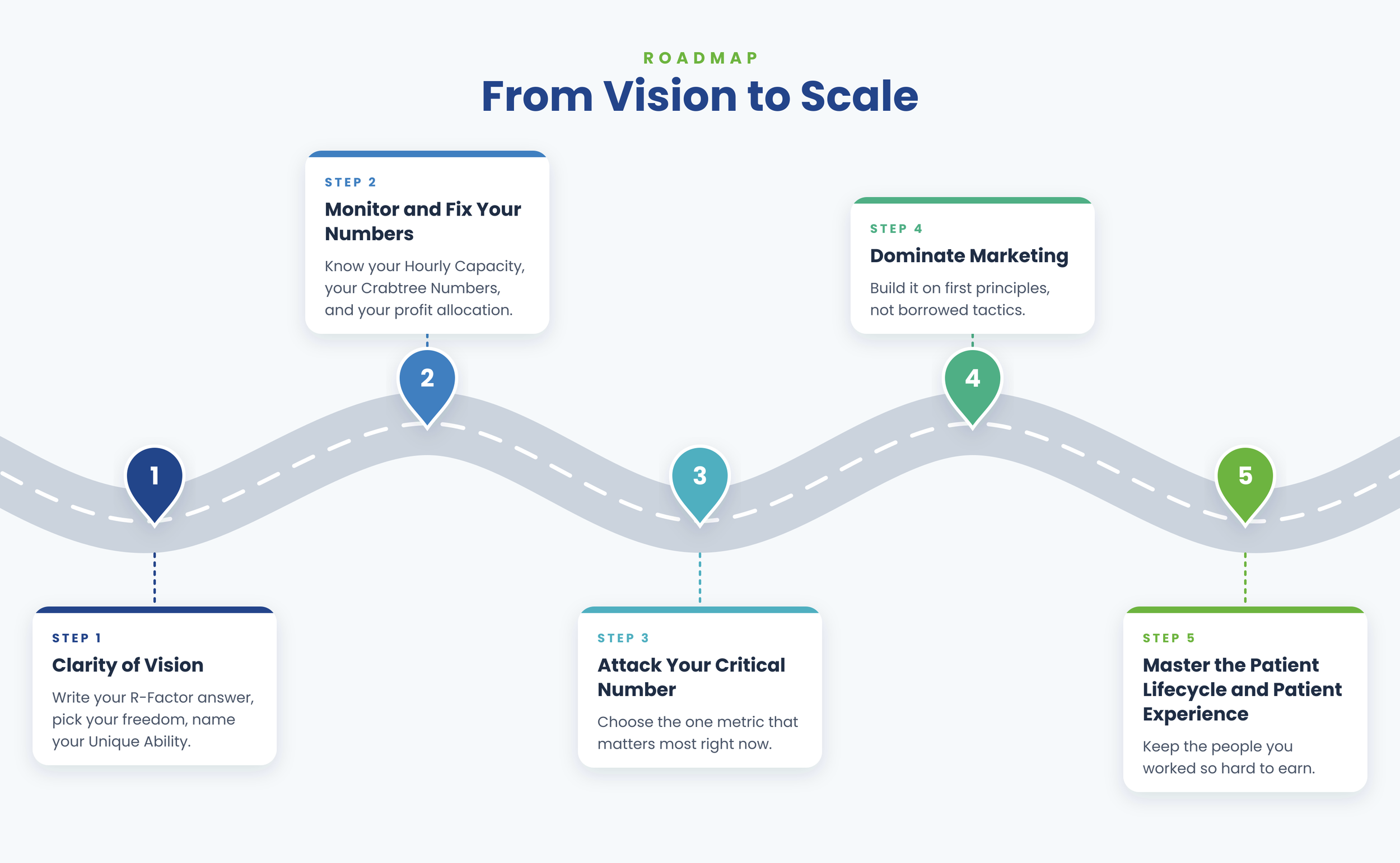
For each step, ask two questions: Where are you doing well? And where do you need to improve? Write both down. The gaps are your plan.
Frequently Asked Questions About Scaling a Chiropractic Practice
-
Scaling a chiropractic practice starts with defining your vision, understanding your financial performance, identifying your most important growth metric, and improving the patient experience. The goal is to increase revenue without a proportional increase in operating expenses.
-
Growth generally involves increasing revenue alongside operating expenses while maintaining profitability. Scaling focuses on increasing revenue significantly without a proportionate increase in expenses.
-
Important chiropractic practice metrics include Office Visit Average (OVA), Hourly Capacity, operating profit margin, associate ROI, new patients, patient adherence, and patient retention. The most important metric to prioritize depends on the practice's current challenges.
-
Chiropractors can improve patient retention by evaluating every stage of the patient journey, from initial scheduling and the first visit to active and supportive care, as well as inactive patient communications. Identifying where patients disengage helps practices focus on improving the patient experience.