
The Chiropractic Patient Experience: Why Day 1 is the Highest-Leverage Hour in Your Practice
I remember the first new patient I ever "lost." Not to a competitor or insurance, but because her Day 1 experience didn't hold together. The exam was great. The findings were solid. I had a treatment plan that I genuinely believed would help her. But at checkout, the front desk had no idea what I'd told her in the room, so she left confused and unsure about the game plan. This was my fault, not the front desk's.
That one stung because it wasn't a clinical failure. It was a design failure. Nobody had ever sat down and decided what "our Day 1" actually looked like, step by step, so that every person on the team, not just me, could execute it the same way every time with every patient.
Here's the plain truth: your patient experience technically runs from the first phone call through discharge, but almost all the leverage lies on Day 1. That's the day a stranger decides whether to trust you with their body and their money. Get it right, and you've built the foundation for a patient who sticks with care and gets a real outcome. Get it wrong, and no amount of clinical brilliance downstream will save you.
So we built a framework. We call it the Day 1 Visit, a six-step process that takes a chiropractic new patient from the parking lot to a scheduled plan of care.
The 6 Steps of a Successful Chiropractic New Patient Visit
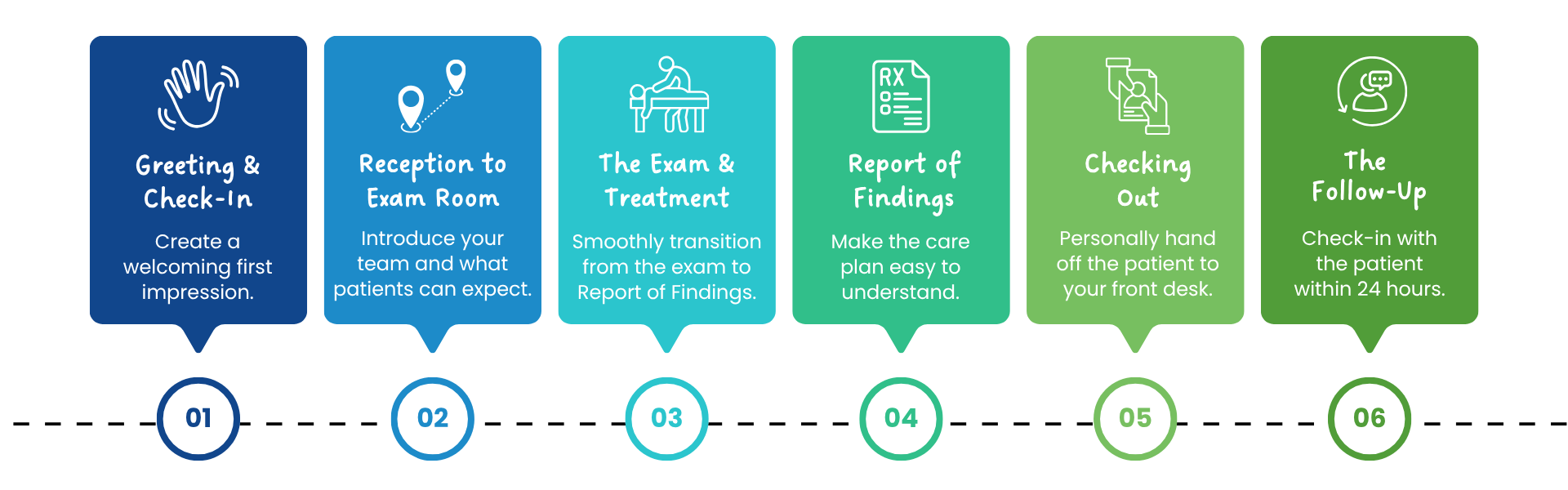
This isn't a script. What you do clinically, whether you treat on Day 1 or Day 2 or when you deliver your Report of Findings, is your call to make. What isn’t optional is that your whole team knows exactly what your Day 1 looks like and can repeat it flawlessly.
1. Greeting & Check-In
The moment someone walks through your door, they're forming a first impression against a healthcare system that's trained them to expect indifference. Greet them by name. Offer coffee or water before they even sit down. None of this is complicated. Almost nobody else in healthcare does it, which is exactly why it works.
2. Reception to Exam Room
This is your office tour, and it's doing more work than most practices realize. Walk the patient past your treatment and rehab area and tell them what's ahead: "We start with the end in mind. Over the next several weeks, you'll be doing some in-clinic work to build durability around this injury."
Introduce every team member you pass by name and role. And before the patient ever meets you, have your CA or intern talk you up by sharing your training, specialty, and experience with treating this specific condition.
3. The Exam and Treatment
This is your clinical core, and no one is here to tell you how to practice. What matters is deciding, as a team, exactly where the patient goes when the exam or treatment concludes. Don't leave that "willy-nilly," dependent on whatever room happens to be open. Designate a report room that is quieter, more private, and free of equipment in view, then route every new patient there without exception.
You can also make the exam room feel more welcoming by placing a small gift basket for new patients. It’s a simple gesture that shows patients you’re glad they’re there and that you’ve taken the time to make their visit feel personal.
4. Report of Findings & Treatment Plan
This is where trust turns into commitment. Teach to different learning preferences by talking through the findings, showing them on an app, and letting them touch and feel what you're describing.
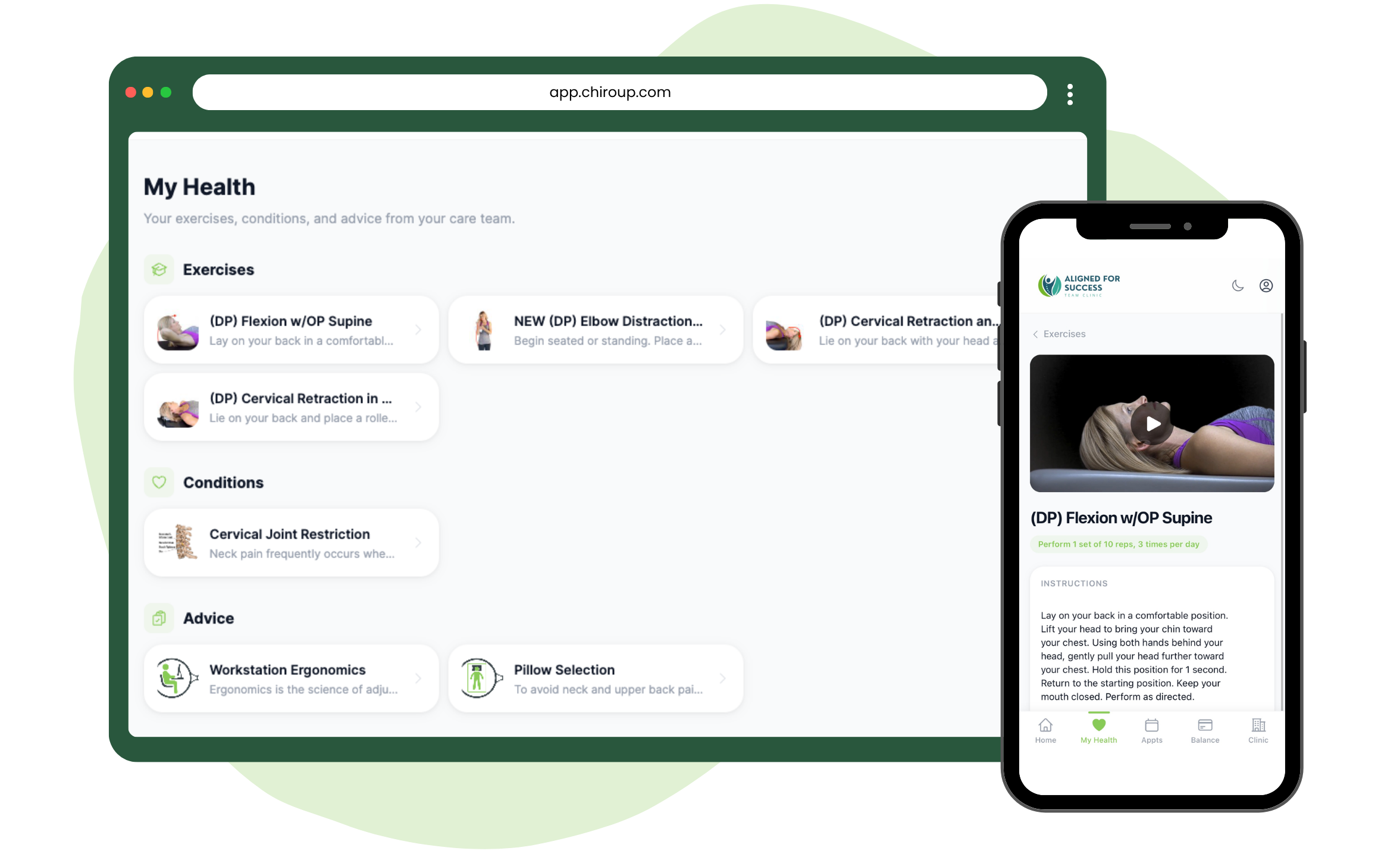
You can easily present all of this information with ChiroUp's Condition Reports. Prescribe the report, print it out, and walk them through their care plan. Then have them pull out their phone and download the HealthCom app so they can easily follow along with their prescribed exercises.
Once the plan is presented, display the options for committing to it: a package discount, a payment plan, or pay-as-you-go. Your goal is to have 70-80% of new patients schedule that first phase of care before they leave your building.
5. Checking Out
Walk the patient to the front desk yourself, then restate the plan out loud in front of both the patient and your team. That single move closes what is otherwise the most common breakdown point in a practice: the doctor tells the patient one thing, the front desk hears something else, and the patient walks out confused. Shake their hand and hand them off personally: "Susan’s going to take care of you from here."
6. The Follow-Up
Reach out within 24 hours. A call, a text, or a short video. The format doesn't matter as long as it's consistent every time. Almost nobody in healthcare checks in on how a patient is doing after they leave. That final touch puts a bow on the whole visit.
The Psychology Behind the Chiropractic New Patient Experience
Each of those steps rests on Robert Cialdini's seven principles of influence — reciprocity, commitment and consistency, social proof, authority, liking, scarcity, and unity. Cialdini didn't write his research for chiropractors, but the translation into your exam room is almost embarrassingly direct.
Consider how these principles show up throughout a typical Day 1 visit:
Reciprocity: The gift basket in the exam room? People feel obligated to return a favor.
Commitment and consistency: The front desk scheduling the entire first phase of care in one sitting? Small, specific commitments made out loud make people far more likely to follow through.
Social proof: Sharing stories or testimonials from patients with similar conditions.
Authority: Talking up the treating doctor before the patient ever walks in.
Liking: Genuine warmth from every single team member.
Scarcity: A practice excellent enough that it's genuinely the scarce commodity in your community.
Unity: Finding the shared identity, whether it's the runner, the CrossFitter, or the parent from the same school, wherever it's authentic.
None of this is sales for its own sake. If you're using these principles to talk a patient into care they don't need, you're not building a practice; you're building a house on quicksand. But you are not that person. You went into this field to help people, and the more effectively you influence a patient to commit to and stick with a treatment plan they understand they need, the better their outcome will be. Ethical, elegant influence in the service of patient outcomes is not a euphemism. It's the whole point.
Building It Is a Commitment, Not a Memo
Here's where most practices stall out. They read something like this, nod along, maybe scribble a few notes, and change nothing. A framework on paper doesn't train a team. What does it mean to work through the Strategic Coach concept of the 4 C's: Commitment, Courage, Capability, and Confidence, with every step above?

Commitment: Actually deciding, as a team, what your Day 1 looks like: which room, which script, which beverage options, who owns the gift basket, and who delivers pricing.
Courage: Having the conversation with your team that "we've always just kind of done it our own way" no longer works.
Capability: Training it. Record a model tour, record a model Report of Findings, and onboard every new hire using those recordings, specifically before their first new patient ever walks in.
Confidence: What shows up on the other side when your whole team can execute Day 1 without depending on who happens to be working that day.
I lost that patient years ago because I hadn't done any of this work. I'd love to tell you it never happened again right away; it took a few more lessons before I documented what our Day 1 was supposed to be. Don't wait for your version of that story. Sit down with your team this week and answer one question honestly: “If I asked every person on staff to describe our Day 1, would I get the same answer twice?” If not, that's your starting point.
Your Day 1 should be consistent. Your tools should be, too.
ChiroUp makes it easy to deliver personalized condition reports, patient education, and prescribed exercises while giving your team a simple way to keep the patient experience moving from the exam room to home.