
You’ve seen patients with pelvic floor dysfunction (PFD) in your chiropractic practice. You may not have known it, but you have. One in four women (a statistic that is known to be underreported) has some amount of PFD, and men experience PFD as well.
Stress urinary incontinence (SUI) is the most prevalent (leaking of any amount of urine when physical stress is placed upon the bladder and pelvic floor, such as from a cough, laugh, sneeze, or activities like running and jumping).
In a 2018 poll, women aged 50-80 were asked about incontinence, and 43% of those women under 65 reported experiencing it daily (which increased to 51% over 65), but 67% didn’t report their symptoms to their doctor.1 This means ⅔ of women over 50 who are unable to control their bladder don’t even mention this health problem to their doctors.
This means you have to ask if you want to find out. But maybe you’re not sure how to help.
That’s part of what I help chiropractors (and patients) do: improve pelvic floor function.
I wrote an entire book and have multiple courses regarding core and pelvic floor function. I also teach continuing education courses solely about improving pelvic floor function. I am confident in what we as chiropractors can do for them to decrease PFD. But I still rely on patients actually doing their part of the equation. This is where ChiroUp makes a huge difference.
Pelvic floor dysfunction is often multifaceted, so things like lifestyle modifications, nutrition, and a home exercise plan are crucial in a full functional recovery. Cue the ChiroUp Condition Report.
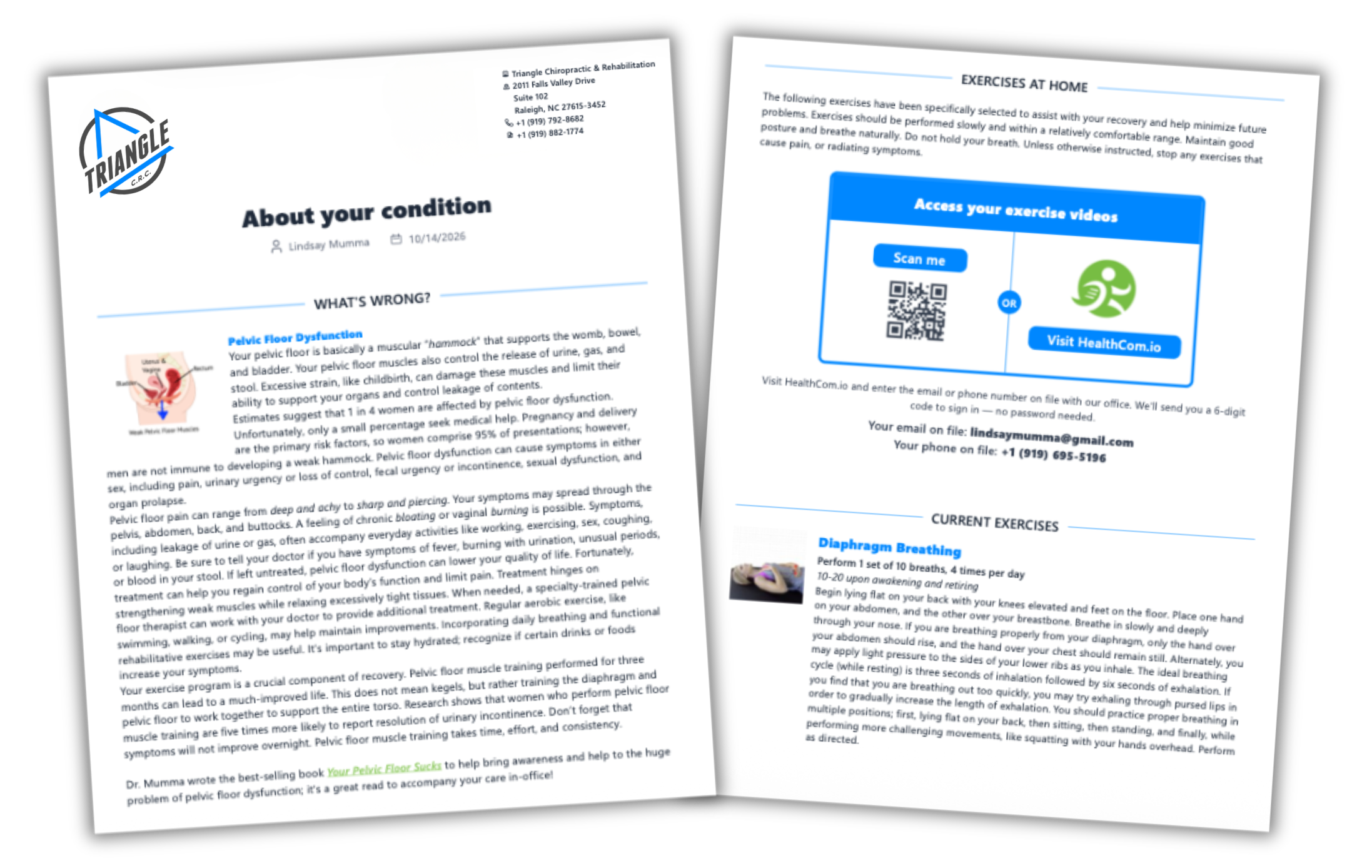
We can only do so much patient education in the room. I need patients to understand how their posture, workstation, breathing, stress, nutrition, and even their footwear are all impacting their pelvic floor. Sure, some of my patients will read my book, but most prefer the short, digestible snippets included in the Condition Report.
The Condition Report affirms what I say in the treatment room, plus some of what I don’t get a chance to say. It’s as informative for the patient as it is for their PCP, who then understands more of what chiropractic care is and can do.
Additionally, exercises are a huge part of how I treat patients, but not just in my treatment room. We only do a few reps of an exercise to introduce it to patients, and then send their exercises via ChiroUp with a description and video. This is way more efficient than following up each visit with an email full of links. Here are two videos I added to my personal ChiroUp exercise library—Child’s Pose and Phonetic Cueing—so I can quickly and easily share them with my patients.
Through ChiroUp, I now have the planned progression of exercises for each condition, including PFD, ready to go. I’ve been able to modify these to fit the flow of my practice and then easily pass the information and exercises along to my patients.
I’ve helped hundreds of women stop peeing their pants, and it’s a whole lot simpler with ChiroUp. Chiropractors are uniquely positioned to improve pelvic floor function in our patients. By asking the right questions, applying the right treatments, and using ChiroUp to share patient education and home exercises, we can help turn the tide on the epidemic of pelvic floor dysfunction.
If you want to learn more about how chiropractic care plays a huge role in improving PFD, join me for Your Pelvic Floor Sucks: The Course or grab my best-selling book, Your Pelvic Floor Sucks.