
Glute Weakness and Chronic Low Back Pain: What the Latest Research Really Says
Many people believe weak glutes are a major cause of chronic low back pain, but the relationship is more complicated than it appears. Research shows that individuals with chronic low back pain may exhibit differences in gluteus medius strength, activation, and movement strategies, but weakness alone does not account for every case.
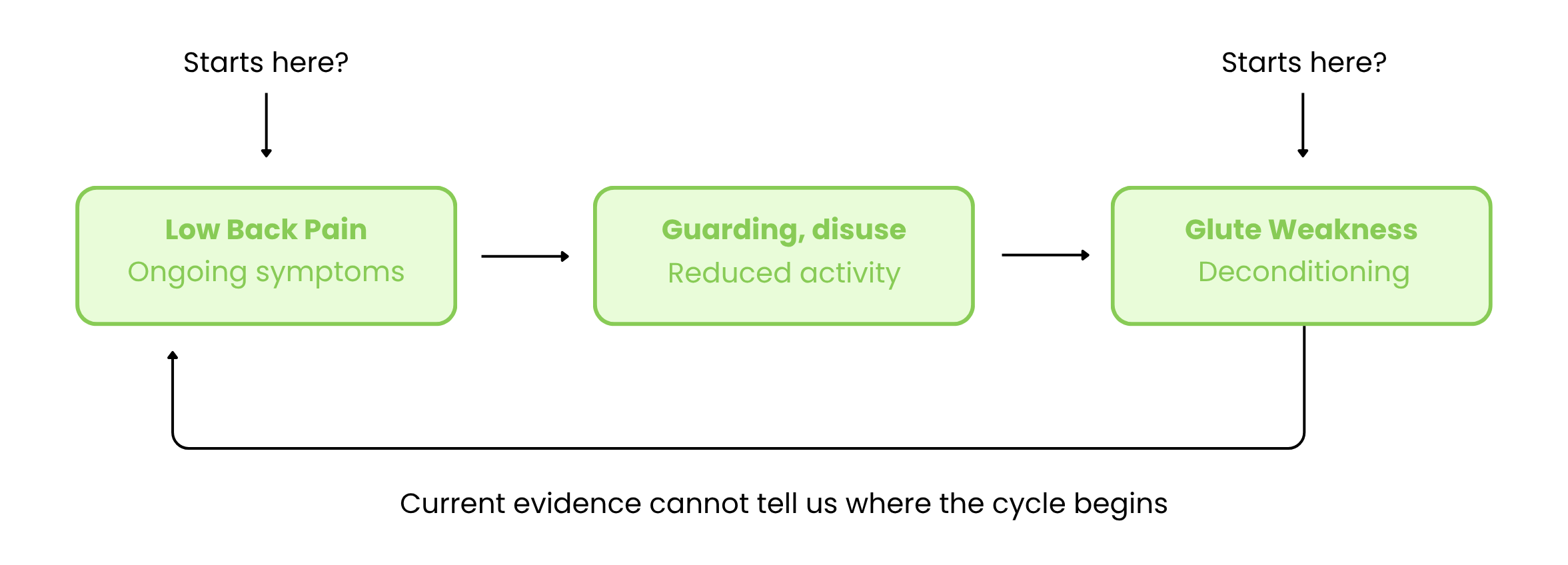
A consistent finding in the literature is that the gluteus medius tends to be weaker in those with chronic low back pain (CLBP) compared to pain-free controls. However, it's unclear whether that weakness is a cause of CLBP or a consequence. Individuals with CLBP often become deconditioned over time, whether through reduced activity, protective guarding behaviors, or simply moving less due to fear of pain, and current evidence can't tell us whether this deconditioning precedes the pain or follows it.
What Does Research Say About Glute Activation in Chronic Low Back Pain?
When it comes to gluteus medius activation (measured via EMG), the picture gets more complicated, and this is where clinicians need to be careful.
A 2019 systematic review found inconsistent results across studies: some showed increased activation in CLBP patients, others showed reduced activation, and some showed no difference. (1) So the blanket cue "you need to activate your glutes more to stabilize your lower back" may help some patients but not all.
New Research on Gluteus Medius Activation and Low Back Pain
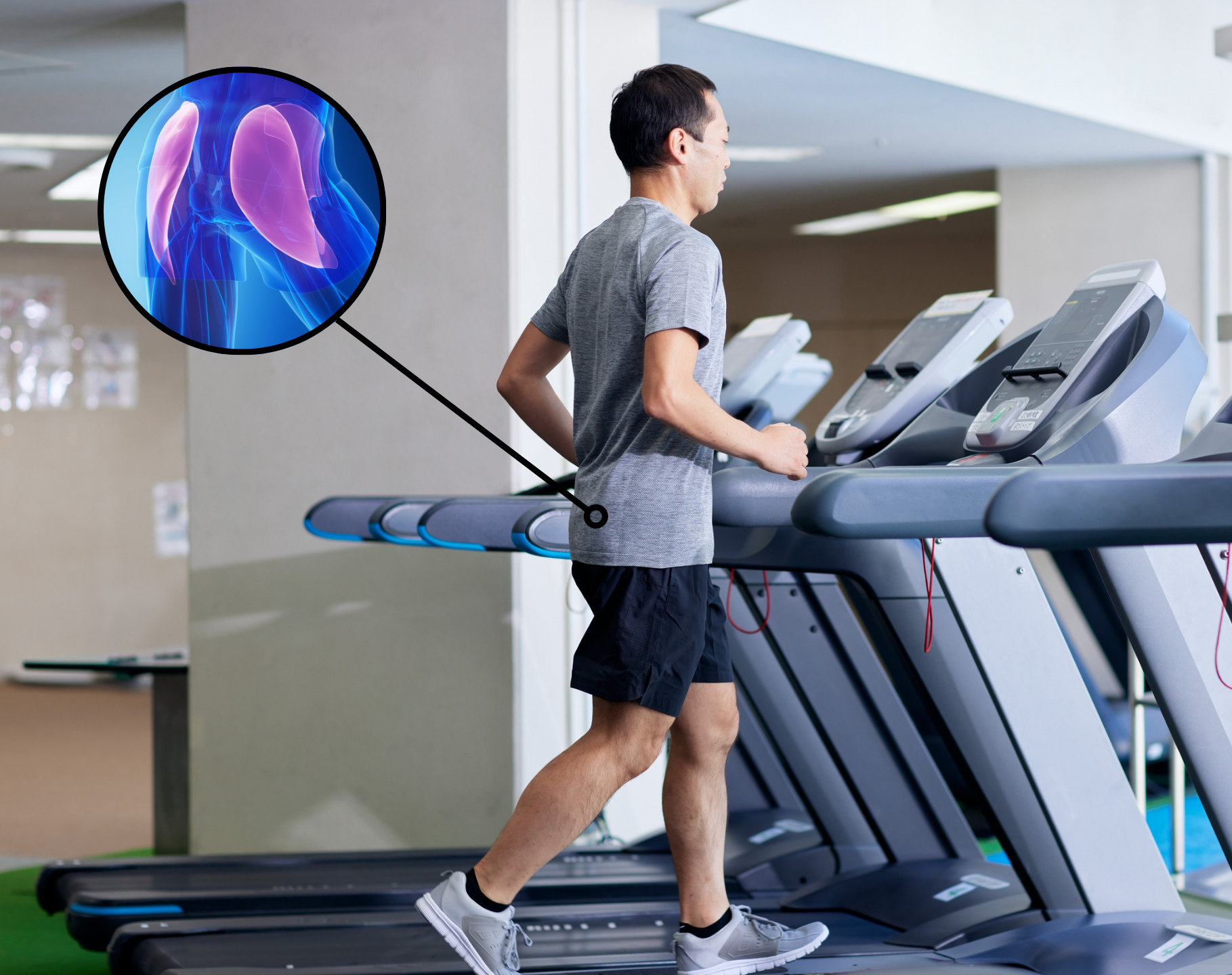
A 2026 study adds important weight to this caution. (2) Researchers compared gluteus medius activation during a sustained 10-minute treadmill walk in CLBP patients versus matched controls.
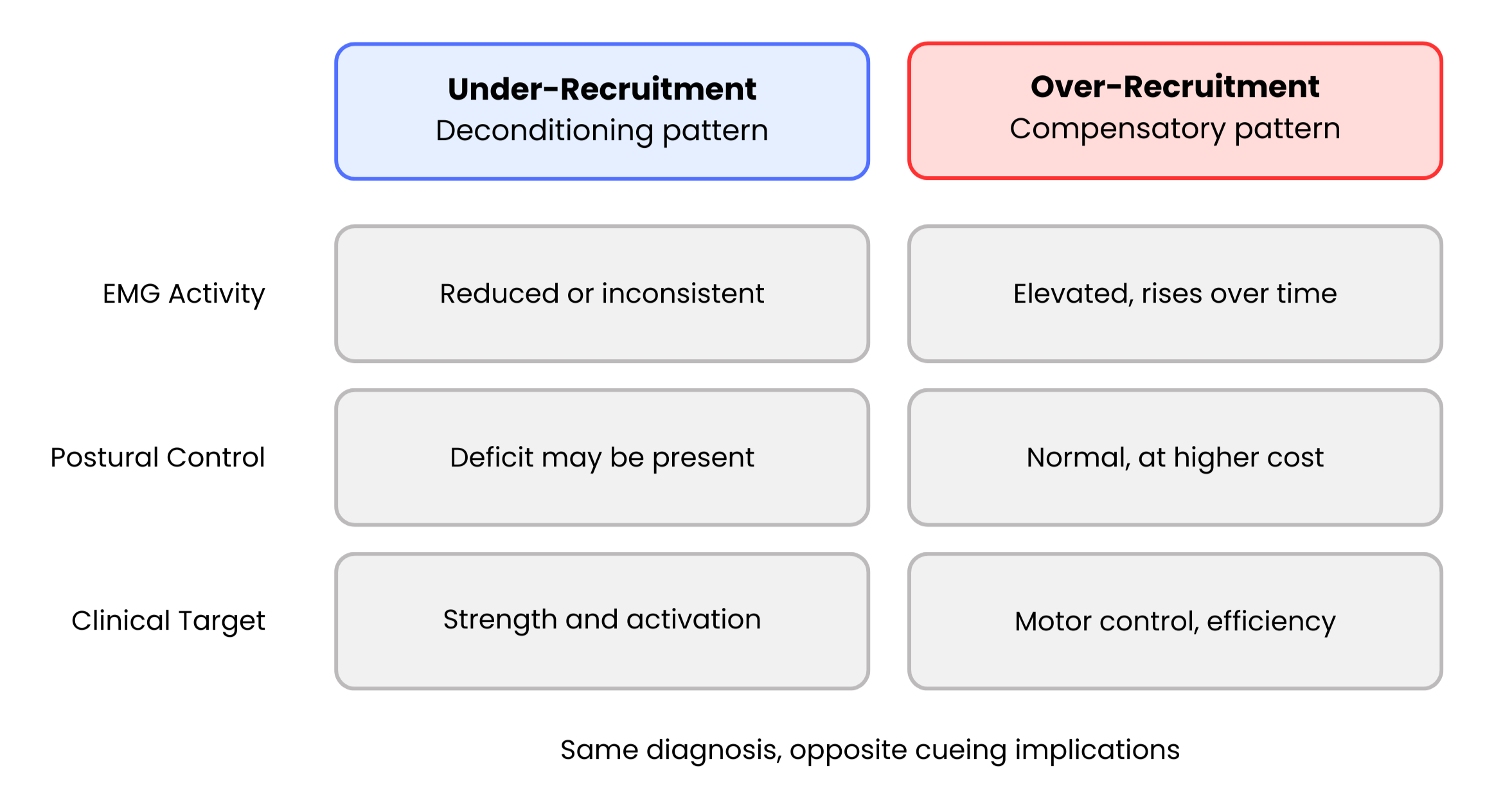
Rather than finding reduced activation, the CLBP group showed significantly greater gluteus medius activity than controls, with the difference becoming most pronounced in the final two minutes of the walk.
Notably, center-of-pressure measures showed no difference between groups, indicating that the CLBP group maintained normal postural control, albeit at a higher neuromuscular cost.
The authors interpreted this as a compensatory strategy: patients were substituting effortful hip muscle recruitment for reduced intrinsic spinal stability, and this strategy became more pronounced as the task went on—a pattern consistent with earlier prolonged-standing research showing that increased, not decreased, glute co-activation predicted who would go on to develop low back discomfort. (3)
Why Glute Activation Matters in Chronic Low Back Pain Treatment
This matters clinically because it's the opposite of the pattern assumed by the "activate your glutes more" cueing.
If a patient is already over-activating and compensating through the hip, adding more conscious activation cueing on top of that could reinforce an already effortful, guarded strategy rather than resolve it.
There's also a broader movement-pattern concern. Individuals with CLBP often move with a more rigid, guarded strategy overall, and cueing more glute activation risks reinforcing that guarding rather than restoring more normal, efficient movement.
Key Points for Clinical Practice
Glute strengthening can be one useful component of a broader rehabilitation program for CLBP, but it's one of several effective exercise strategies rather than a targeted fix. General exercise, motor control retraining, and graded activity approaches all have supporting evidence, and no single approach has been shown to be clearly superior. (4)
Deeper dive: watch our free on-demand webinar, Functional Deficits Part III: Hip Abductor Weakness and Lower Cross Syndrome. It covers the latest evidence-based assessment techniques, treatment strategies, and practical rehab exercises you can use in practice.
Clinicians should match activation strategies to the demands of the activity. Low-demand tasks like walking, sitting, and standing don't require much glute activation to begin with. In fact, some CLBP patients may already be over-activating during these tasks as a compensatory strategy. Cueing can help modify pain in the short term, but should be used carefully to avoid reinforcing guarding or fear-avoidant movement patterns.
Where increased compensatory activation is suspected, the more useful clinical target may be to improve neuromuscular efficiency and motor control rather than simply adding strength work, since the mechanism behind improvements in glute-focused trials doesn't appear to be strength gain itself.
Conclusion
The relationship between the gluteus medius and chronic low back pain is more complex than the simplistic notion that "weak glutes cause back pain." While strengthening the glutes can play an important role in rehabilitation, current evidence suggests that clinicians should avoid assuming that every patient with CLBP requires increased gluteal activation. Instead, treatment should be guided by the individual's presentation, movement strategy, and functional demands. The goal isn't simply to increase muscle activity, but to restore efficient, confident movement with the right amount of muscular effort.
Frequently Asked Questions
-
Glute strengthening can be one useful component of a broader rehabilitation program for CLBP, but it should not be viewed as a targeted fix. General exercise, motor control retraining, and graded activity all have supporting evidence, and no single approach has been shown to be clearly superior.
-
Current evidence cannot determine whether glute weakness causes chronic low back pain or develops as a consequence of pain, reduced activity, or protective movement behaviors.
-
Not necessarily. Research has shown that some individuals with chronic low back pain already demonstrate increased gluteus medius activation during everyday activities. In these cases, additional activation cueing may reinforce compensatory movement patterns rather than improve them.
-
Low-demand activities such as walking, sitting, and standing require relatively little glute activation. Because some patients with CLBP may already be over-activating these muscles, cueing should be used thoughtfully so it does not reinforce guarding or fear-avoidant movement patterns.
-
When increased compensatory activation is suspected, improving neuromuscular efficiency and motor control may be a more appropriate clinical target than simply adding strengthening exercises. The mechanism behind improvement in glute-focused rehabilitation does not appear to be strength gains alone.
-
Sadler S, Cassidy S, Peterson B, Spink M, Chuter V. Gluteus medius muscle function in people with and without low back pain: a systematic review. BMC Musculoskelet Disord. 2019;20:463.
Sornkaew K, Punyaphing K, Wongonta T, Phinthong S, Kiewsiri N. Increased gluteus medius activation during sustained walking in chronic low back pain: a compensatory strategy for mediolateral postural control. Gait Posture. 2026;129:110218.
Marshall PWM, Patel H, Callaghan JP. Gluteus medius strength, endurance, and co-activation in the development of low back pain during prolonged standing. Hum Mov Sci. 2011;30(1):63-73.
Ceballos-Laita L, Estébanez-de-Miguel E, Jiménez-Rejano JJ, Bueno-Gracia E, Jiménez-Del-Barrio S. The effectiveness of hip interventions in patients with low-back pain: a systematic review and meta-analysis. Braz J Phys Ther. 2023;27(2):100502.