
Chiropractic Fee Schedules: Why Billing Every Insurance Company the Same Fee Matters
Many chiropractors have been taught that it is illegal to charge different insurance companies different amounts for the same service. That is not necessarily true. There is no universal rule making payer-specific fee schedules inherently illegal. However, payer contracts and federal and state programs may restrict how charges are established, so practices should verify the requirements applicable to each payer.
But just because you can maintain different fee schedules doesn't mean you should. When developing a chiropractic fee schedule, there are compelling financial, billing, and professional reasons to establish a reasonable fee schedule rather than changing your charges to match every insurance company's allowable amount.
Consider a simple example. Your clinic determines that the reasonable fee for a chiropractic manipulation is $60. One health plan may allow only $35, while another allows $45. Instead of changing your charge to match each insurer's reimbursement, bill your established $60 fee and allow the contractual adjustment to reflect the difference.
1. Chiropractic Insurance Billing: Don't Let 100% Payment Hide Poor Reimbursement
Imagine billing ABC Health Plan $35 because you already know its allowable amount for the chiropractic service is $35. Your claim comes back:
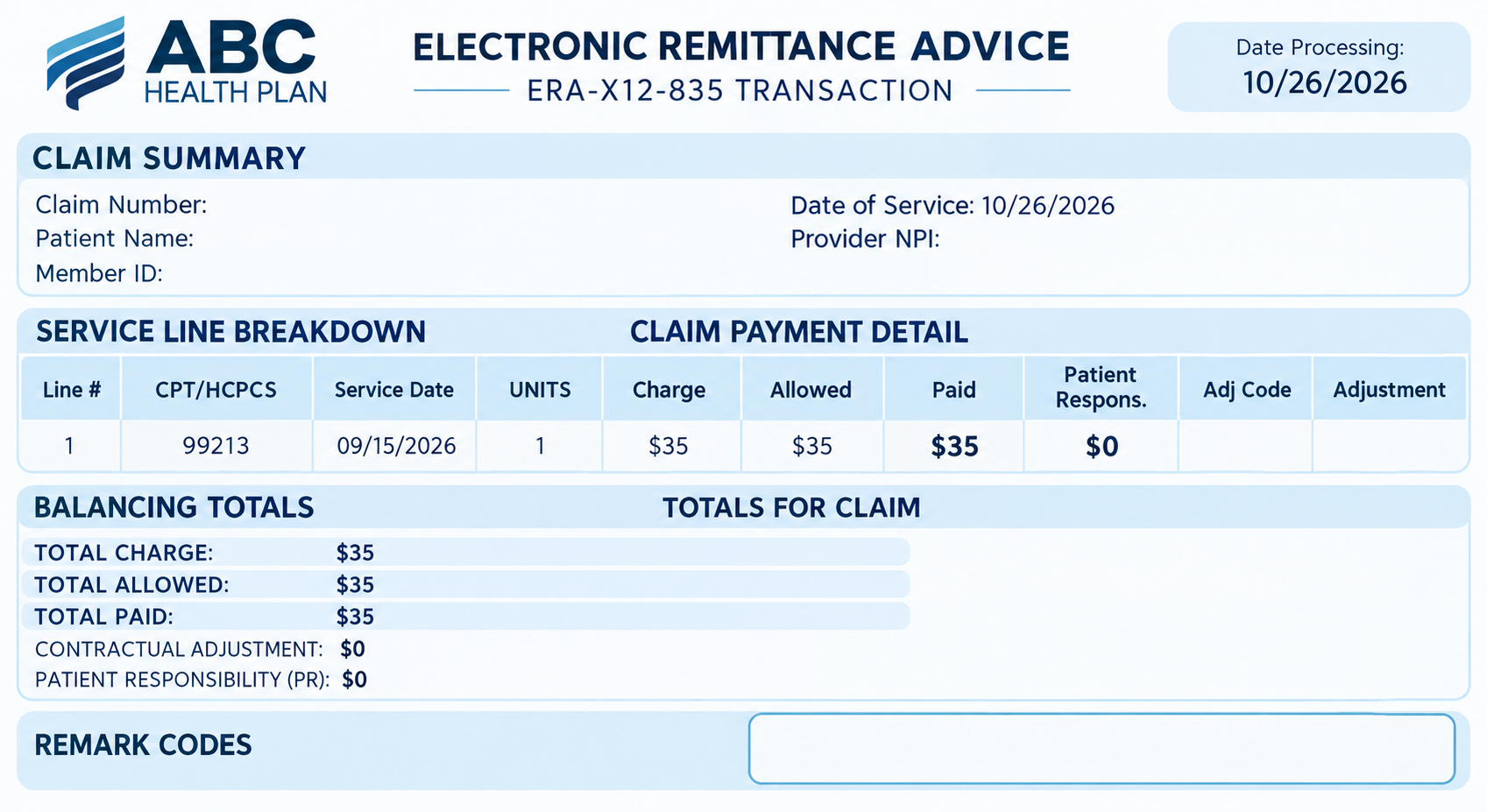
On paper, the insurance company has allowed 100% of your charge. That sounds fantastic until you realize that the chiropractor deliberately lowered the charge to match what the insurance company was willing to pay. Now consider billing your established $60 fee:
Charge: $60
Allowed: $35
Contractual adjustment: $25
Suddenly, the economics become much clearer. The insurer isn't recognizing 100% of the established charge your practice assigned to the service. Its contracted allowable represents only 58% of your established charge. That distinction matters when chiropractors evaluate payer contracts, analyze chiropractic insurance reimbursement, and discuss reimbursement trends within the profession.
2. Your Chiropractic Fee Schedule Should Reflect the Cost and Value of Care
An insurance company's allowable is not necessarily a declaration of what chiropractic care is worth. It is the amount the payer has agreed to recognize under a particular reimbursement arrangement. Those are two very different numbers.
A chiropractic practice fee schedule can account for legitimate business factors such as doctor and staff time, malpractice coverage, EHR technology, chiropractic documentation requirements, facilities, supplies, inflation, administrative burden, and the professional resources required to deliver the service.

If a chiropractic clinic simply changes its charge to whatever each insurance company allows, the payer's reimbursement methodology effectively becomes the chiropractor's pricing methodology.
3. Billing Too Little Can Actually Cost a Chiropractic Practice Money
Setting your charge to match each payer's expected allowable may eliminate contractual write-offs, but it can also leave money on the table. Some reimbursement methodologies pay the lesser of your submitted charge or the payer's allowable amount.
This is particularly important when considering insurance billing for chiropractic. If a service has an allowable amount of $45, but your submitted charge is only $40, the lower submitted charge will limit reimbursement. A $0 contractual adjustment doesn't necessarily mean you were reimbursed well. Sometimes it means you didn't bill enough to receive the full allowable.
Secondary coverage provides another reason to avoid tailoring your submitted charge solely to the primary payer's expected allowable amount. Primary and secondary plans may use different allowable amounts and coordination-of-benefits methodologies, so practices should not assume that a charge optimized for the primary payer will produce the same result when secondary coverage is involved.
A single, reasonable chiropractic fee schedule helps avoid this problem: bill your established fee consistently, let each payer determine its allowable amount, and post the appropriate contractual adjustment.
ChiroUp makes this process easier by automatically adjudicating write-offs when you post an ERA. See how simple it can be in the video below.
4. Chiropractic Billing Write-Offs Tell an Important Story
Chiropractic billing write-offs and contractual adjustments aren't necessarily bad. They are valuable data.
Suppose a chiropractic practice provides $500,000 in services according to its established fee schedule, but contracted insurance companies recognize only $325,000. That represents $175,000 in contractual adjustments, or 35% of charges.
That number tells a story. It demonstrates the gap between what a chiropractic practice charges for delivering care and what third-party payers recognize under their contracts. It also allows the practice to compare payers:
Payer A recognizes 58% of charges.
Payer B recognizes 75%.
Payer C recognizes 82%.
That is far more informative than configuring multiple chiropractic fee schedules so every insurance company appears to reimburse 100% of submitted charges.
5. Why Chiropractic Reimbursement Data Matters to the Profession
There is a larger professional issue. If chiropractors continually lower their submitted charges to match insurance company allowables, claims data can create the appearance that insurance companies are paying chiropractors extremely well.
A payer that allows $35 on a $35 submitted charge appears to recognize 100% of the chiropractor's charge. That makes it more difficult to demonstrate the economic pressure created by stagnant chiropractic insurance reimbursement.
There is also a broader professional consideration. Consistently setting submitted charges equal to payer allowables can obscure the difference between what practices charge and what insurers contractually recognize. Although charge-to-allowable data alone does not establish whether reimbursement is adequate, preserving that distinction provides practices and professional organizations with more meaningful data for evaluating reimbursement trends.
6. Chiropractic Billing and Documentation Need to Tell the Same Story
Maintaining one reasonable and defensible fee schedule isn't about artificially inflating charges or attempting to collect contractual write-offs from patients. Contractual adjustments must still be honored, and patient responsibility must comply with applicable payer contracts and law.
Instead, good chiropractic billing and documentation should work together to accurately represent the services provided, the charges associated with those services, the payer's allowable amount, patient responsibility, and what was ultimately collected.
A single fee schedule also creates cleaner analytics. A chiropractic practice can independently measure gross charges, contractual adjustments, payer allowables, insurance payments, patient responsibility, and net collections.
If our chiropractic claims repeatedly tell insurance companies, "You paid 100% of what we asked for," we shouldn't be surprised when it becomes difficult to demonstrate that reimbursement doesn't keep pace with the cost and value of providing chiropractic care.
Sometimes the write-off isn't just an accounting nuisance.
It's evidence of the reimbursement gap.
Frequently Asked Questions: Chiropractic Billing and Fee Schedules
-
No. Having different charges or fee schedules is not inherently illegal. Federal Medicare regulations recognize circumstances in which a provider may vary charges for the same service and establish rules for determining a provider's customary charge when charges vary.
However, that does not mean every payer permits every type of fee-schedule arrangement. Chiropractic practices still need to consider individual insurance contracts and applicable federal and state requirements, including Medicare, Medicaid, and workers' compensation rules.
Takeaway: Multiple chiropractic fee schedules aren't automatically illegal, but they aren't automatically permissible in every payer situation either.
-
Instead of relying on arbitrary figures or simple multipliers, such as 150% of Medicare, practitioners can develop a more robust chiropractic fee schedule by using objective market data and professional benchmarks. A powerful resource for this process is the FAIR Health Fee Estimator, which provides specific charge data for the chiropractic specialty across nearly 500 geographic regions. By examining percentile benchmarks, clinics can gain a clear understanding of what local colleagues are charging for specific procedures.
This market-based data can also be compared with CMS Relative Value Units (RVUs), which reflect the relative work, practice expense, and malpractice components associated with different services. Together, geographic charge benchmarks and relative resource information can provide objective reference points when a chiropractic practice develops and periodically reviews its fee schedule.
-
No. The goal isn't to manufacture enormous contractual adjustments. Your chiropractic fees should be reasonable, defensible, and established according to a consistent methodology. A better philosophy is:
Charge what your practice reasonably believes the service is worth, not simply the highest number your chiropractic billing software will accept.
A contractual write-off is useful when it accurately reflects the difference between your established charge and the payer's contracted allowable amount. Artificially increasing fees merely to create a larger adjustment defeats that purpose.
-
Potentially, yes. Some reimbursement methodologies pay the lesser of the provider's submitted charge or the applicable fee-schedule amount. If an insurer allows $45 for a chiropractic service but your practice submits only $40, the submitted charge may limit reimbursement, depending on the payer and contract.
This is particularly important when evaluating Medicare chiropractic billing and claims involving secondary insurance. Takeaway: Don't automatically assume eliminating contractual write-offs improves your revenue cycle. A $0 adjustment could simply mean your submitted charge was too low.
-
Generally, not when the chiropractor has contractually agreed to accept the payer's allowed amount.
For example:
Chiropractic charge: $60
Insurance allowed amount: $40
Insurance payment: $32
Patient coinsurance: $8
Contractual adjustment: $20The practice generally collects the $32 insurance payment and the $8 patient responsibility, and adjusts the remaining $20 according to the payer agreement. The contractual adjustment should not simply be transferred to the patient.
The reverse is also important. Chiropractic practices shouldn't routinely waive established deductibles, copayments, or coinsurance simply because they don't want to collect them.
A More Meaningful Way to Look at Reimbursement
A reasonable, consistent chiropractic fee schedule does more than simplify billing. It helps practices understand what they charge, what insurance companies recognize, and where reimbursement falls short.
Rather than adjusting charges to make every payer appear to reimburse 100%, establish a defensible fee schedule, honor contractual adjustments, and use your billing data to evaluate reimbursement more accurately.
The goal isn't to make write-offs disappear. It's to make them meaningful.
ChiroUp EHR helps chiropractic practices connect the dots between documentation, billing, and reimbursement. With tools for efficient documentation, insurance billing, and automated ERA posting, your team can spend less time managing the details and more time understanding the financial story behind your care.
Want to see how ChiroUp EHR can simplify your practice's billing and documentation workflow?